
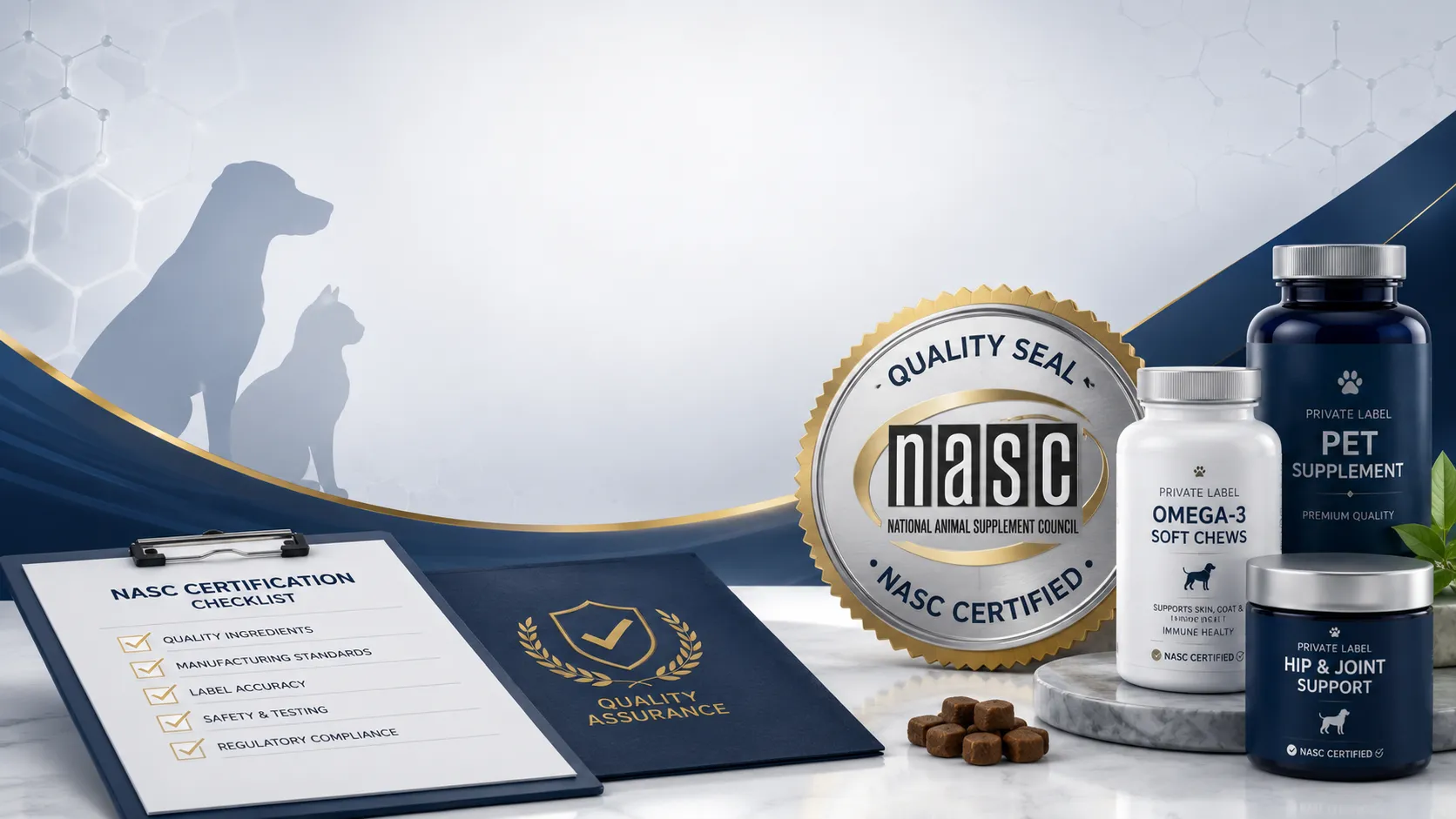
How To Get NASC Certification for Private Label Pet Supplements
The National Animal Supplement Council (NASC) Quality Seal is the gold standard for pet supplement quality and safety. For private label businesses, obtaining NASC certification demonstrates commitment to excellence and builds consumer trust in a competitive market.
1. Understanding NASC Certification Value
NASC certification provides significant competitive advantages for private label pet supplement brands. The seal gives a buyer an independent standard to point at, rather than a claim written by the brand. The certification signals that products meet rigorous quality standards, undergo regular audits, and comply with FDA guidelines. Major retailers like Chewy, Petco, and Amazon prioritize NASC-certified products, making certification essential for market access.
2. NASC Membership Requirements
Before certification, companies must become NASC members. Membership requirements include:
Company Legitimacy - Valid business registration, tax identification, and operational history of at least 12 months.
Quality Commitment - Documented quality management system, standard operating procedures, and quality control processes.
Regulatory Compliance - Understanding of FDA regulations, state requirements, and labeling guidelines.
Financial Stability - Ability to invest in quality systems and maintain ongoing compliance.
Membership is billed annually and scales with company size; a separate application fee applies at the start.
3. Quality System Development
NASC certification requires comprehensive quality documentation
Quality Manual - Documented quality policy, objectives, and organizational structure. A template can be bought or written in-house.
Standard Operating Procedures (SOPs) - Detailed procedures for manufacturing, testing, labeling, and distribution. This is written work: someone has to own it, draft it and keep it current.
Batch Records - Documentation systems for ingredient tracking, production records, and quality testing. The system has to be in place before the first batch, and it is filled in per batch afterwards.
Corrective Action Systems - Procedures for handling quality issues, customer complaints, and product recalls. This is a procedure set plus the records that prove it was followed.
4. Facility and Manufacturing Standards
NASC auditors evaluate manufacturing facilities against cGMP standards:
Facility Requirements - Clean, organized production environment with pest control, sanitation programs, and proper ventilation. Any upgrade is a capital item, quoted per site after an inspection.
Equipment Standards - Calibrated, maintained equipment with documented maintenance schedules. Calibration is scheduled work, priced per instrument and per visit.
Ingredient Storage - Proper storage conditions, inventory management, and traceability systems. Storage and traceability are set up once and maintained from then on.
Production Controls - Documented manufacturing processes, in-process checks, and quality verification points.
5. Testing and Quality Control
NASC certification requires robust testing protocols
Ingredient Testing - Certificate of Analysis (COA) verification for all raw materials. Testing is priced per ingredient, so the bill scales with the length of the formula.
Finished Product Testing - Potency verification, contaminant screening, and stability testing. Finished-product testing is priced per product.
Microbiological Testing - Regular testing for pathogens, yeast, and mold. Microbiological testing is priced per batch and repeated on a schedule.
Third-Party Laboratory - Use of accredited laboratories for all testing. The annual budget depends on how many SKUs and batches run through the year.
6. Labeling Compliance
NASC requires compliant labeling that meets FDA and state requirements:
Product Claims - Substantiated claims with supporting evidence. Legal review is priced per set of claims, and it happens before the artwork is signed off.
Ingredient Listing - Complete, accurate ingredient listing following AAFCO guidelines.
Directions for Use - Clear dosage instructions based on animal weight and condition.
Manufacturer Information - Complete contact information and NASC member identification.
Label development and compliance review are priced per product.
7. Audit Preparation and Process
NASC audits facilities on a scheduled cycle:
Pre-Audit Assessment - Internal audit to identify gaps and corrective actions. The internal audit is run as a project and produces the gap list the corrective actions work from.
Documentation Review - NASC reviews quality documentation before facility visit.
Facility Inspection - On-site evaluation of manufacturing processes, facility conditions, and quality systems.
Corrective Actions - Address any non-conformances identified during audit. Corrective action is scoped after the audit, so it is quoted per finding.
Audit fees are charged per audit, plus the auditor's travel.
How to ask for a quote: send the supplier your SKU count, the formats and pack sizes, the markets you sell into, and the tests your buyer requires. Ask for the quote split into one-off and recurring work: membership and application, documentation and SOPs, facility and calibration work, ingredient testing per ingredient, finished-product and microbiological testing per batch, label and claims review per product, and the audit itself. Ask what the audit fee includes and what is billed as travel, and which documents you receive at the end — normally a gap list, an audit report and the certificate scope. A quote that arrives as one total tells you nothing about the second year.
8. Timeline and Cost Summary
Timeline: certification is a multi-month process from application to sign-off
Initial Investment: certification and audit work in the first year, scaled to company size and to the quality systems already in place
Annual Maintenance: membership, ongoing testing and scheduled audits, billed annually
Cost Breakdown:
- Membership and application
- Quality system development
- Facility improvements
- Testing and compliance
- Audit and certification
9. Maintaining Certification
Ongoing compliance requirements include
Annual Audits - Regular facility inspections and documentation reviews.
Adverse Event Reporting - Mandatory reporting of product-related adverse events to FDA and NASC.
Continuous Improvement - Regular quality system reviews and updates.
Regulatory Updates - Stay current with changing FDA and state regulations.
10. Return on Investment
NASC certification delivers business benefits
Market Access - Eligibility for major retail channels that require NASC certification.
Consumer Trust - the seal gives shoppers a standard they can check without reading the ingredient list.
Reduced Liability - documented procedures and batch records mean a problem can be traced and scoped.
Premium Pricing - certification supports a higher shelf price; how much depends on category and channel.
Brand Differentiation - Clear competitive advantage in crowded market.
NASC certification represents a significant investment but delivers substantial returns through market access, consumer trust, and competitive positioning for private label pet supplement businesses.