

Allergy Support Chews for Dogs: A Private Label Guide
The hard part of an allergy line is not the formula. It is the wording: the same chew with omega-3 and a botanical can be described as supporting the normal skin barrier, or described in a way that makes it a drug.
That distinction is not a marketing nicety. It decides which regulatory category the product sits in, what evidence the label implies, and how much of your margin goes to refunds and reviews when an owner expects a flare to stop and it does not.
The ingredients in this category are ordinary: fat, a few botanicals, a probiotic or two, an antioxidant. The risk sits on the pack, and the pack is written last by people who are thinking about a photograph.
The pack is the risk.
This guide is for the buyer specifying a private label allergy-support line, and it treats the claim as part of the specification rather than as something the designer handles later.
Why this line is a claims problem first
An allergy is a diagnosed condition, and anything that claims to act on a condition is treated as a drug in most markets, with a different evidence standard and a different approval path.
A supplement cannot cross that line by being gentle or natural. It crosses it by what the label says the product does. Support language about normal function stays on the supplement side; language about a condition, a flare, or a reaction moves the product to the other side, and the ingredients do not matter at that point.
That is why this category produces so many recalls and warning letters from small brands. The formula is fine, the manufacturer is fine, and the pack says the one thing it should not.
The commercial consequence is also real. A claim that promises an outcome the product cannot deliver produces a customer who returns the pack, writes a review, and never buys again. A modest claim produces a customer who renews, because the product did what the pack said.
Write the claim first, then build the formula around it.
What buyers usually ask for in the formula
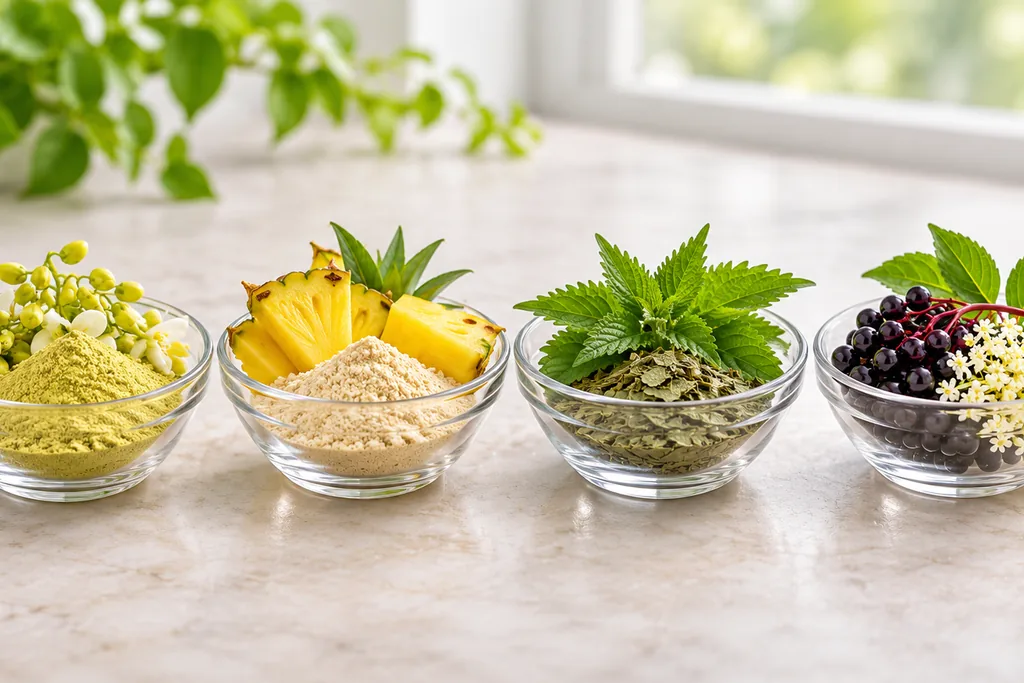
Enquiries in this category name four groups of ingredients, and each has a role in the formula that is worth understanding before the price conversation.
Omega-3 fatty acids are the anchor, because the skin is a tissue with fast turnover and its barrier depends on the fat profile. EPA and DHA are the parts that matter, and the source decides the taste, the allergen statement and the oxidation risk.
Botanical ingredients are the second group. Quercetin is the one buyers ask about most, usually because it appears in human allergy products. In a formula it is an ingredient with a sourcing and documentation question attached, not a shortcut to a claim.
Probiotics appear in newer formulas for the gut-skin link. The mechanism is plausible and the marketing is ahead of the evidence, which is a reason to include a strain with documentation rather than a blend chosen for the label.
Antioxidants, vitamin E in particular, do double duty. They protect the oil in the formula and they are a nutrient in their own right, and the same level can serve both purposes.
Four groups, and none of them is a ranking of importance. What matters is that the formula carries a real level of the anchor ingredient, because the rest of the panel is decoration if the fat is token.

The barrier story, told correctly
The defensible story in this category is the skin barrier, and it is defensible because it is about normal function rather than about a condition.
The barrier is the outer layer of the skin. Its job is to hold water in and keep irritants out, and it depends on fat, on zinc, and on the proteins that hold the skin cells together. A formula that supports the barrier is supporting a structure the body maintains anyway, which is a support claim.
The same formula also supports a normal immune response, in the sense that the skin is an immune organ and its normal function includes responding appropriately to what it meets. That phrasing describes normal function, not a reaction being blocked.
The barrier is a structure, not a symptom.
What the story cannot do is promise to calm, stop or block a reaction, because those words describe an effect on a condition. The moment the copy moves from "supports the barrier" to "stops the reaction", the product changes category on paper while the formula stays the same.
If the omega-3 sourcing is still open, the comparison of omega-3 sourcing for pet supplements covers the fatty acid profiles and the allergen consequences in more detail than this section does.
Support the structure, not the symptom.
Format: chews, powder or drops
Seasonal demand shapes the format decision more than it does in other categories, because the product is bought in a burst and then sits in a cupboard.
Chews are the default because they behave like a treat and the owner gives them without measuring. They also carry the masking problem: a fish oil and a botanical both have to be hidden, and the room the masking takes comes out of the oil load.
Powder is easier to formulate and harder to sell. It mixes into food, which suits owners who already supplement, and it carries a larger panel at a real level. For a seasonal product it has one advantage: a jar that is opened occasionally loses less than a chew that dries out between seasons.
Drops are the easiest to give and the most delicate to keep. Small volumes over food suit picky dogs, and the formulation work concentrates on stability and taste masking in a liquid base.
The right format is the one the buyer's customer will use through a season without giving up, and a supplier should ask that question before quoting.
Claims that get a product flagged
This is the section to hand to whoever writes the pack, because the difference between a compliant claim and a flagged one is often a single verb.
The support version reads like this: "Supports the skin barrier and a normal immune response as part of a seasonal routine." It describes normal function, it makes no promise about a flare, and it is the kind of statement a documented formula can defend.
The version that gets flagged reads like this: "Stops itching during allergy season and calms flare-ups within days." It describes an effect on a condition, it implies a timeline, and it turns the product into a drug claim. That sentence is the example of what not to write, and it should be shown to the artwork team so it does not come back in a friendlier form.
The vocabulary that triggers it is small and predictable: words that promise a symptom will stop, words that describe reducing it, words that describe treating a condition or keeping it from starting, and words that position the product against allergies as a category. Each of them reads as a drug claim regardless of the ingredient list.
There is also a middle ground that catches careful writers: a sentence that starts as support and ends as outcome. "Supports skin comfort during seasonal changes" is a support claim. "Ends seasonal scratching" is a result in a condition.
Keep the two vocabularies in separate documents, and never let the artwork brief contain both.
What to test for a seasonal product
A seasonal product has a longer idle period than a continuous one, which changes what the testing has to prove.
The oil has to be tested for oxidation, because a product that sits in a warehouse between seasons spends that time oxidising. Peroxide value and anisidine value on the raw material, and again on the finished product after a stability run, are the numbers that show whether the fat survived.
The panel has to be verified on the finished piece, not just in the blend, because forming and drying a chew changes what is left. Vitamin E deserves its own check for the reason already given: the level that stabilises the oil and the level claimed on the pack should be the same number, and the assay is how you find out whether they are.
Palatability has to be tested with the actual base, because a seasonal buyer cannot afford a product the dog refuses in week one. A chew that smells of fish and tastes of mineral is a return, whatever the panel says.
Retained samples matter more here than in a continuous line. If a complaint arrives at the start of the next season, the retained sample from the batch is the only way to separate a bad batch from bad storage in a cupboard.
Test for the idle period, not only for the day of packing.
MOQ, seasons and the first order
The commercial terms are the same across formats on this site, so the first-order decision is about timing rather than about volume.
A first order is 100 units per SKU with a custom label and bottle. A printed outer carton raises the threshold to 500 units, because the carton is a separate print item with its own minimum. Samples take 3–5 working days. Production runs 20–25 working days from confirmed formula, artwork and deposit, with an expedited run at 10–15 working days when capacity allows.
For a seasonal line, the useful habit is to count backwards from the shelf date rather than forwards from the purchase order. Work back through production, artwork approval, sample rounds and the buyer's own listing deadlines, and the date the deposit has to be paid becomes obvious. A batch that arrives after the season has started is inventory, not sales.
The first SKU should also be the smallest sensible one, because a seasonal product carries the extra risk of being wrong for a whole year. A 100-unit run proves the formula, the pack and the palatability before a full season's volume is committed.
Allergy support chews for dogs is the format most private label brands start with in this category, and the work goes into the oil level and the claim wording rather than the shape of the piece.
Count backwards from the shelf date.
FAQ
Can an allergy chew stop my dog from itching?
Not as a claim. A product that promises to stop itching is describing an effect on a condition, which is a drug claim in most markets. What this category can say is that it supports the skin barrier and a normal immune response as part of a routine. The distinction is not about how strong the formula is; it is about what a supplement is allowed to say it does.
Is quercetin safe for dogs?
That is a question for the market and the formula, not a yes or no. Quercetin appears in supplements for dogs, and whether it belongs in your product depends on the target market's rules, the level used, and the documentation the ingredient supplier can provide. A buyer should ask the manufacturer what documentation it has for the ingredient, and should not treat an appearance in a human product as evidence that it fits a canine one.
What is the difference between allergy support and immune support?
Immune support speaks about normal immune function: supporting the body's normal response. Allergy support speaks about the skin barrier and normal immune function in the specific context of seasonal change. Neither can describe action on a diagnosed condition. The practical difference is the section of the pack the claim sits in and the review it needs, not the regulatory boundary, which is the same.
When should a seasonal product be produced?
Work backwards from the date the product needs to be on the shelf, not from today. Production takes 20–25 working days from confirmed formula, artwork and deposit, an expedited run takes 10–15, and samples take 3–5. Add the buyer's listing deadline and the margin you want for a slow first sell-through, and the order date falls out of the arithmetic rather than from a general rule.
What is the minimum order?
100 units per SKU with a custom label and a bottle. Adding a printed outer carton raises the minimum to 500 units, because the carton is a separate print item. The formula tier does not change, so a 100-unit trial and a 500-unit run can use the same formula.
Can I call it hypoallergenic?
Better not to. The term implies that the product cannot trigger a reaction, which is a claim about an outcome in a condition and cannot be supported by a supplement formula. It also invites scrutiny from a regulator and a challenge from a customer whose dog reacted anyway. Describe what the product supports, not what it cannot cause.
Write the pack the way the formula can defend.