
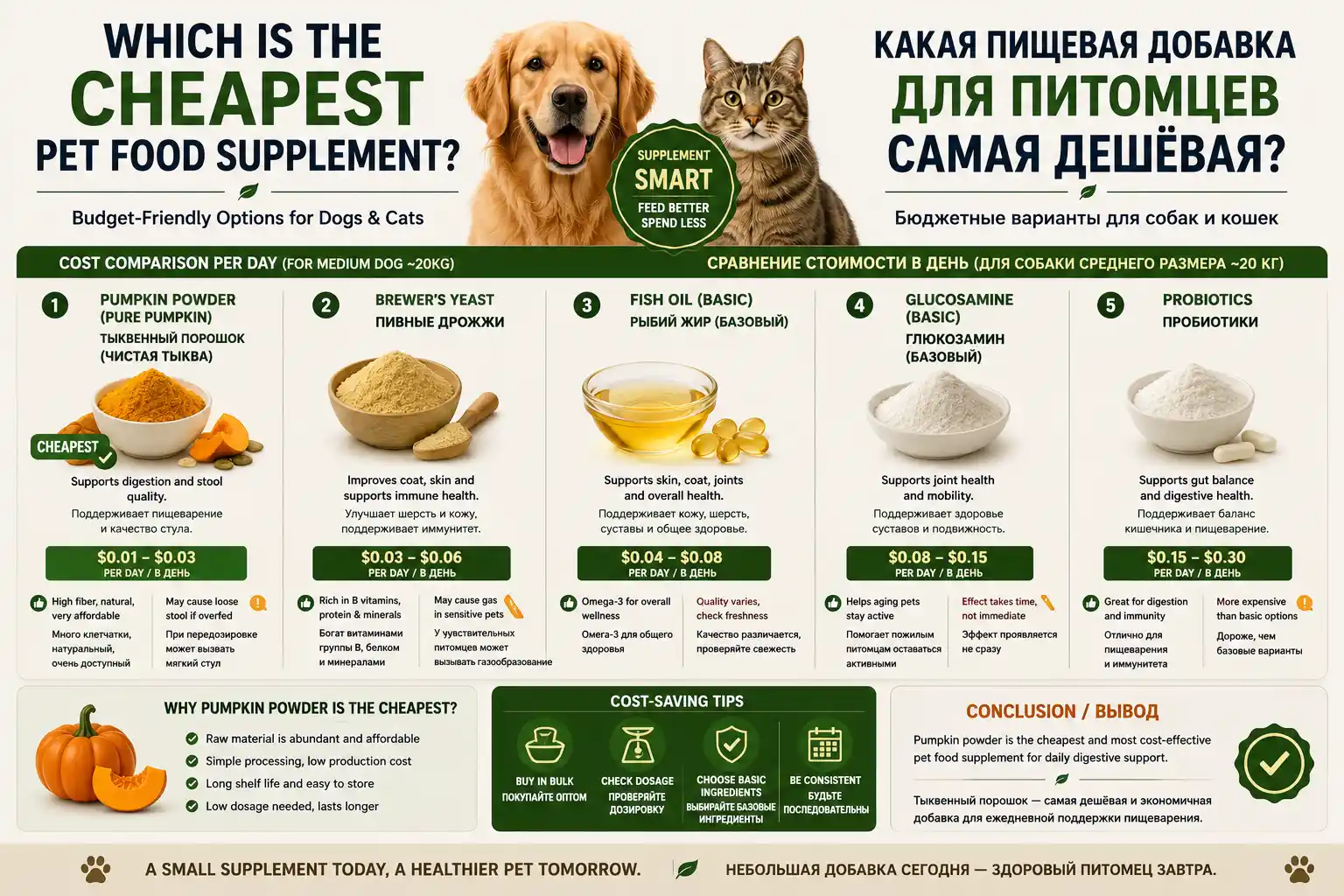
Why the Cheapest Pet Supplement Is Not the Cheapest Per Serving
Walk into a pet store and the cheapest pack on the shelf is easy to spot. What that pack costs per day of use is harder to see, and it is the number that decides whether a brand makes money or a customer comes back.
We do not quote prices here. Prices move with raw material markets, freight and the market you sell into, so any figure printed here would be wrong by the time you read it. What we can give you is the method: what drives cost per serving, where a cheap formula hides its expense, and how to compare two quotes on the same basis.
Why the Label Price Doesn't Tell the Full Story
The shelf price answers a different question from the one buyers actually need. A pack price tells you what one purchase costs. It does not tell you how many days that purchase covers, how much of the active ingredient is in each serving, or how much the formula has to overage to stay in spec at the end of shelf life.
Four things separate the two numbers.
Serving count. A pack with a large serving size runs out sooner. The same pack price can mean twice the daily cost, purely because the label tells the owner to feed more.
Inclusion level. Two formulas can carry the same ingredient and deliver very different amounts of it. The cost per gram of delivered nutrient is the only comparison that survives a spec sheet.
Overage. A formula that loses potency during storage has to start with more of the active to meet the label claim at the end. That extra material is paid for in every batch, not once.
Format and packaging. Chews need texture control, liquid needs preservation and a bottle, powder needs moisture control and a barrier film. The format you choose sets a floor under the cost before a single ingredient is priced.
Cost Per Serving — The Only Number That Matters
Cost per serving is simple arithmetic done on the right inputs. Take the delivered amount of the actives per serving, adjust for what the batch needs to overage, add the losses you expect in production, and divide the finished cost by the number of servings in the pack.
The method matters more than the arithmetic, because the inputs are where quotes stop being comparable.
Ask for the finished-product cost, not the raw material price. Ask what serving size the quote assumes. Ask whether the overage is already inside the cost or sits on top of it. Ask which tests the price includes and which are billed separately. A supplier who answers those four questions can be compared with another supplier who answers them the same way; a supplier who quotes a per-kilogram price cannot.
There is also a timing element. A formula that needs reformulation every year because an ingredient loses stability will cost more across a product's life than a slightly more expensive formula that holds its spec. Cost per serving is a five-year number as much as a batch number.
Multivitamins: Why the Per-Serving Math Works
Broad-spectrum formulas are the easiest category to price per serving, because the actives are commodity ingredients, the inclusion levels are small, and the finished product is stable in more than one format.
That is also why a multivitamin is a poor place to look for savings. The formula is already cheap at the raw material level, so the money sits in packaging, serving size and order volume rather than in the ingredient list. The saving per serving is small, and the loss in stability or taste can be larger than the gain in material cost.
Where format does move the number is convenience. Powders carry the lowest packaging and handling cost; chews add process and texture work. A brand that lists multivitamin chews for dogs is paying for the chew, not for the vitamins, and the quote should say so explicitly.
Joint Supplements — Cheap Bottle, Long Commitment
Joint formulas invert the usual logic. The actives are bulky, the daily serving is large, and many products need more than one unit per day to hit the label claim. A bottle can look inexpensive on the shelf and still work out as the most expensive habit in the range, simply because a pack does not last long.
Two details decide the real cost.
The first is serving size versus pack size. A formula with a large serving and a small pack has a short days-of-supply, whatever the shelf price says.
The second is how much of the formula is carrier. A joint chew that reaches its serving weight with fillers costs less to make and delivers less per serving; a denser formula costs more and lasts longer. Neither is automatically right, but the comparison has to be made on delivered actives, not on pack weight.
For a first run, the useful exercise is to hold the specification fixed and price two formats against it — joint support chews for dogs against a powder of the same actives. The difference you see is the format cost, and it is the number a private label buyer can actually influence.
Probiotics: Low Raw Material Cost, Higher Stability Cost
Probiotic formulas look like they should be cheap. The strains are produced by fermentation at scale, and the raw material cost per serving is small compared with the retail price.
The money is somewhere else: keeping the organisms alive.
Viability falls with moisture, heat and time, so the formula needs a moisture barrier, a pack that resists humidity, and a shelf life that has been tested rather than assumed. Testing is heavier too: strain identity, viable count at release and viable count at the end of shelf life are three separate results. A blend that looks cheap per kilogram can be the expensive option if it needs refrigeration, a foil laminate and a shorter shelf life to hold its claim.
This is also where per-serving comparison breaks down if you are careless. A product with a high count at release and a low count at expiry is not comparable with one that holds its count, even if the labels carry the same number. A probiotic powder for dogs and cats quote should therefore state the test points, not just the count.
The Real Price of "Too Cheap"
A formula priced below the category floor pays for it somewhere. Four places to look:
Under-dosing. The label claim is met on paper, not in the batch. A certificate of analysis from a real lot settles this; a specification sheet does not.
Unstable actives. Cheap material that loses potency in storage forces overage now and reformulation later. The second batch is where the saving disappears.
Claims without documentation. A claim the file cannot support has to be withdrawn, and withdrawing it means artwork, listings and sometimes stock.
Change of supplier. Re-qualifying a source means new samples, new stability work and a new label review. A cheap switch is rarely cheap once that work is counted.
None of these show up in a per-kilogram quote. All of them show up in cost per serving.
Three Ways to Cut Costs Without Cutting Corners
Match the format to the actives, not to the price list. Bulky actives belong in a format that can carry a realistic serving; unstable actives belong in one that protects them. Choosing the cheapest format and then compensating with overage is the most common way brands add cost they cannot see.
Cut SKU count before cutting specification. Fewer SKUs mean longer runs, shared packaging and fewer changeovers. A tight range with documented formulas is cheaper to run than a wide one with the same total volume.
Plan the order against the real minimum. Our MOQ starts at 100 units per SKU including custom label and packaging, and 500 units when a custom box is included. Standard production runs 20–25 working days after the formula, artwork and deposit are confirmed; the fastest window is 10–15 working days when capacity allows, and sampling takes 3–5 working days. Those are the numbers to build a launch plan around, because they decide how much stock has to sit in a warehouse before the first sale.
The Bottom Line
The cheapest pet supplement is not the one with the lowest shelf price. It is the one whose cost per serving, per delivered active, is lowest after overage, stability and documentation are counted — and that number can only come from a supplier who quotes on the same basis you are comparing.
If you are scoping a run, send us the actives, the serving size, the format and the market, and ask for a quote broken down by ingredient, format, testing and packaging. WanZiBei operates a GMP, ISO 22000 and HACCP facility in Guangzhou and our plant is FDA-registered — a facility registration, not a product approval. We run OEM and ODM work across a broad formula library, and the quote we return will be built to be compared.