
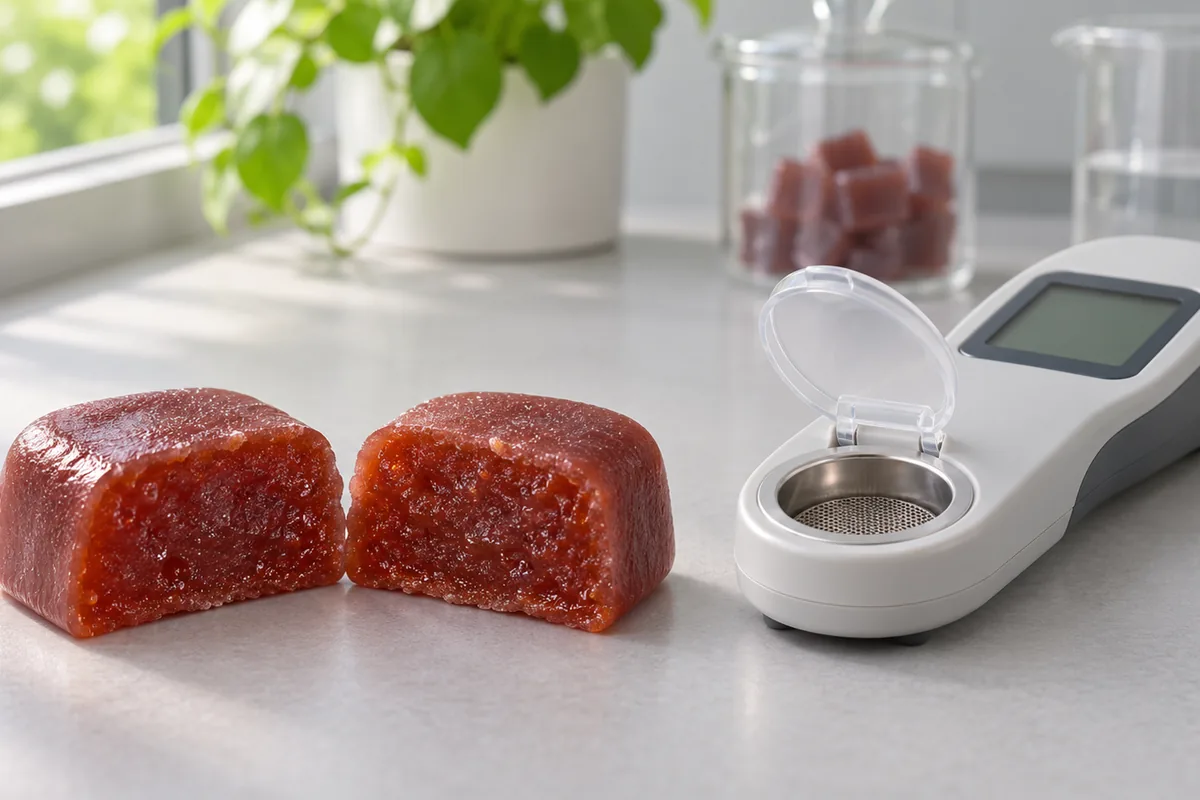
Pet Soft Chew Manufacturing: Formulation and Stability
A soft chew is the easiest format to sell and the hardest to keep stable, because it has to satisfy two demands at once: a dog has to want to eat it, and the actives inside have to still be there at the end of the shelf life. Most failures come from choosing which of those two to sacrifice.
Buyers usually arrive at this format for a commercial reason. A chew reads as a treat, it is easy to feed, and it photographs well on a shelf. What they discover later is that the same moisture that makes a chew soft is the thing that shortens its life, and that every decision afterwards is a trade. Soft chews win because they are the format a pet owner will actually use every day. They lose in the lab because the water that makes them pleasant to eat is the same water that lets actives degrade, seals fail and mould find a home. Same water, two effects.
Why soft chews win on the shelf and lose in the lab
The tension is structural, not a matter of supplier skill. A chew is a semi-moist matrix: gelling agents, humectants and water hold it together, and actives are dispersed inside that matrix. Push the moisture up and the texture improves while stability drops. Pull it down and the product firms up, dries out and gets rejected by the animal.
Whichever end gives way first decides which failure you get. If palatability wins, the product sits at a moisture level where the margin for microbial control is thin and the actives have more freedom to react. If stability wins, the chew becomes hard, waxy or crumbly, and the purchase stops repeating. Then the format dies.
That is why the format decision should not be made on the basis of which one is more popular. It should be made against the active ingredient and the channel: a product sold through a long retail chain needs a longer stable window than one sold direct and turned over quickly.
What a soft chew is made of
A soft chew is a formulated matrix of gelling agents, humectants, water and actives, not a powder pressed into a shape. Change any one of the four and the other three move, which is why copying a competitor's ingredient list rarely reproduces the product. The matrix is the structural part. Gelatin, pectin, starches and similar agents give the chew its body, and each behaves differently under heat and time. The choice decides whether the chew holds its shape in a warm warehouse or slumps in the bag. Heat finds the weak choice.
Humectants hold water in place. Glycerin and similar ingredients keep the chew soft and stop it drying to a stone, and their level is one of the main levers a formulator has over texture. They also change how the surface behaves in contact with packaging.
Actives are the third element, and they are the least flexible. An active has a level at which it can be included without wrecking taste or texture, and that ceiling is often below what a marketing brief asks for. The formulator's job is to find that ceiling rather than to promise past it. Ceilings are real.
Add flavour and preservative systems and the matrix is complete. Every addition shifts water, texture or taste, so the formula is solved as a whole, not ingredient by ingredient.

Water activity decides the shelf life
Water activity, not moisture content, is the number that predicts how a chew will behave. It measures the water available for reactions and microbial growth, and it explains why two chews with the same water content can age completely differently.
Moisture content tells you how much water is in the product. Water activity tells you how much of it is free to take part in chemistry. A chew can be moist and still have low availability if the humectants are holding the water tightly, and that is the state a formulator is trying to reach. That is the target.
Too high, and the consequences are visible to a buyer within weeks. Mould and yeast find purchase, colours shift, and the surface becomes tacky. Seals that were fine at packing start to fail as the product releases moisture into the headspace of the pack.
Too low, and the failure is commercial rather than microbiological. The chew hardens, loses the soft bite that made the format attractive, and the animal stops finishing it. A product that fails this way does not generate a complaint; it generates a drop in reorders. Silent failure is worse. Because water activity governs both, it is the first specification to agree and the first to test on a new formula. Waiting for a stability study to reveal a problem means waiting through the whole study before discovering it, which is why it belongs in the sample stage.
This is also where packaging stops being a detail. The barrier of the pack, the headspace left inside it and the seal integrity all interact with water activity, and a formula that holds in one pack may not hold in another. Private label pet supplements that change pack format late in the project often find this out at the worst possible moment.
Which actives survive a chew, and which do not
Heat-sensitive and oxidation-prone actives can survive a chew if the process is built around them, live cultures mostly cannot, and that difference decides which format fits. The dividing line is whether the ingredient tolerates the temperature, water and time involved in forming the matrix.
Vitamins and many botanical extracts sit in the first group. They lose potency under heat, so the process is arranged to add them late and to keep the temperature as low as the matrix allows. A formulator who adds everything at the start produces a chew with a label claim it cannot meet at the end of the run. Order matters here.
Oils and omega sources sit in the second group. They are susceptible to oxidation, and oxidation shows up as an off smell long before it shows up on a certificate of analysis. Antioxidant systems and low oxygen exposure during mixing do most of the work here.
Live probiotic cultures are the hardest case. A chew is a moist environment, and vegetative cells lose viability over time in moisture, so the format is usually a poor home for them unless a specialised approach is taken. Some producers move to a dried or encapsulated form, and some simply use a different format for that product. Both are honest answers.
The practical consequence for a buyer is that not every active belongs in every format. When a brief asks for a chew because chews sell, and the active is one that does not tolerate the matrix, the honest answer is a different format, not a longer claim on the label.
Texture, size and the palatability panel
Texture and size are chosen together, and they are validated with a panel rather than with an opinion. A chew that is right for a large dog may be rejected by a small one, and a chew that smells right at the bench may still be refused in the bowl. Hardness has a working range. Too firm and the animal loses interest or the chew becomes a choking concern for a small breed. Too soft and it deforms in the pack, sticks to its neighbour and arrives looking damaged. Texture is a spec.
Size follows the animal and the format, which is a commercial decision as much as a technical one. A larger chew carries more active mass but is harder to finish, and a smaller one is easier to accept but limits how much can be included.
Palatability is tested with a simple, repeatable design: animals are offered the candidate and a control, and acceptance is recorded, not judged. What matters is whether the result holds on the second and third day, because novelty explains a lot of first-day interest. Day three is the test.
Results are then used as a gate, not as marketing material. A formula that fails the panel goes back to the flavour and matrix work before the stability study is wasted on it. Running those two steps in the wrong order is one of the most expensive habits in this format. Order is the whole game.
What a production run looks like
A production run is four locked inputs and a schedule: the formula, the specification, the artwork and the deposit. Once those are confirmed, the batch is scheduled, and the clock on production starts at that point rather than at the enquiry.
Production takes 20–25 working days in our plant. An expedited run takes 10–15 working days when capacity allows, and the sample stage takes 3–5 working days, which is a separate clock that does not sit inside the production window. The minimum is 100 units per SKU with a custom label and bottle, which is a realistic size for a first run of a chew. A printed outer carton raises the threshold to 500 units, because the carton is a print run of its own. Print has its own floor.
Before any of that, the formula has to be settled. That means the matrix, the water activity target, the actives and their inclusion levels, and the flavour system, all agreed on samples rather than on paper. A chew that changes after the first batch changes all four.
The format also decides what the buyer can reasonably ask for later. A line built around one chew matrix can extend into a joint product, a skin product or a multivitamin without rebuilding the process; that is how joint support chews as a chewable option sit in the same family as the rest of a chew range rather than as a one-off project.
When a powder or a liquid is the better answer
A powder or a liquid is the better answer when the active cannot tolerate the chew matrix, when the required inclusion is too high for a realistic chew size, or when the channel turns over too slowly for a semi-moist product.
Powders are the usual alternative for live cultures and for anything hygroscopic, because a dry matrix removes the water that causes the problem. They cost the owner a step at feeding time, which is a real cost, but they solve a technical problem a chew cannot. That trade is honest.
Liquids suit actives that are already stable in solution and products where administration is the main barrier. They bring their own constraints: preservative systems, seal integrity and the risk of leakage in transit all have to be designed rather than assumed. Switching format is not a small change. It means new samples, a new stability study, a new label and often a new pack, so it is cheaper to decide the format correctly at the brief than to move later and write off artwork. Decide once, early.
The honest version of the recommendation is usually the one a buyer does not want: the format that sells fastest in a category is not always the right one for the active. A supplier who says so early is more useful than one who quotes the chew and lets the stability study deliver the news.
Send the format you are considering, the actives and the target inclusion levels, and we will tell you which of them the chew matrix can carry and which need a different format. If the answer is that a chew is the wrong home for your active, we will say so before the samples are made rather than after the stability study.
FAQ
What is the minimum order for soft chews?
100 units per SKU with a custom label and bottle. A printed outer carton raises the threshold to 500 units, because the carton carries its own print minimum. The formula is the same at either size.
How long does a soft chew stay stable?
A soft chew's stability depends on water activity, the actives, the pack and the storage conditions, so there is no universal number. It is established for a specific formula and pack by testing over time, and the shelf-life claim should come from that work rather than from a category average.
Can probiotics go into a soft chew?
Probiotics can go into a soft chew, but viability in a moist matrix is the constraint. Vegetative cells lose viability in water, so producers use a protected form of the culture or choose a dry format instead.
Why do soft chews sweat or stick?
A soft chew sweats or sticks when water migrates to the surface, usually because water activity and the pack barrier are out of balance. It becomes tacky in the bag, or dries and hardens. Fixing it is a formula and packaging change, not a coating.
How is palatability tested?
Palatability is tested with a controlled comparison: animals are offered the candidate and a control, and acceptance is recorded over several days rather than a single sitting. The result is used as a gate on the formula, not as a marketing statement about how much dogs like it. If the panel fails, the flavour and matrix work comes before any stability study, because a formula nobody eats does not need a shelf life.
Can the formula be changed after the first batch?
It can, but it is not an edit to one line. Changing the matrix or an active level means new samples, a new water activity target and a repeat stability study, and the label usually follows because the ingredient list changes. Budget the time before the next run, not after it.