
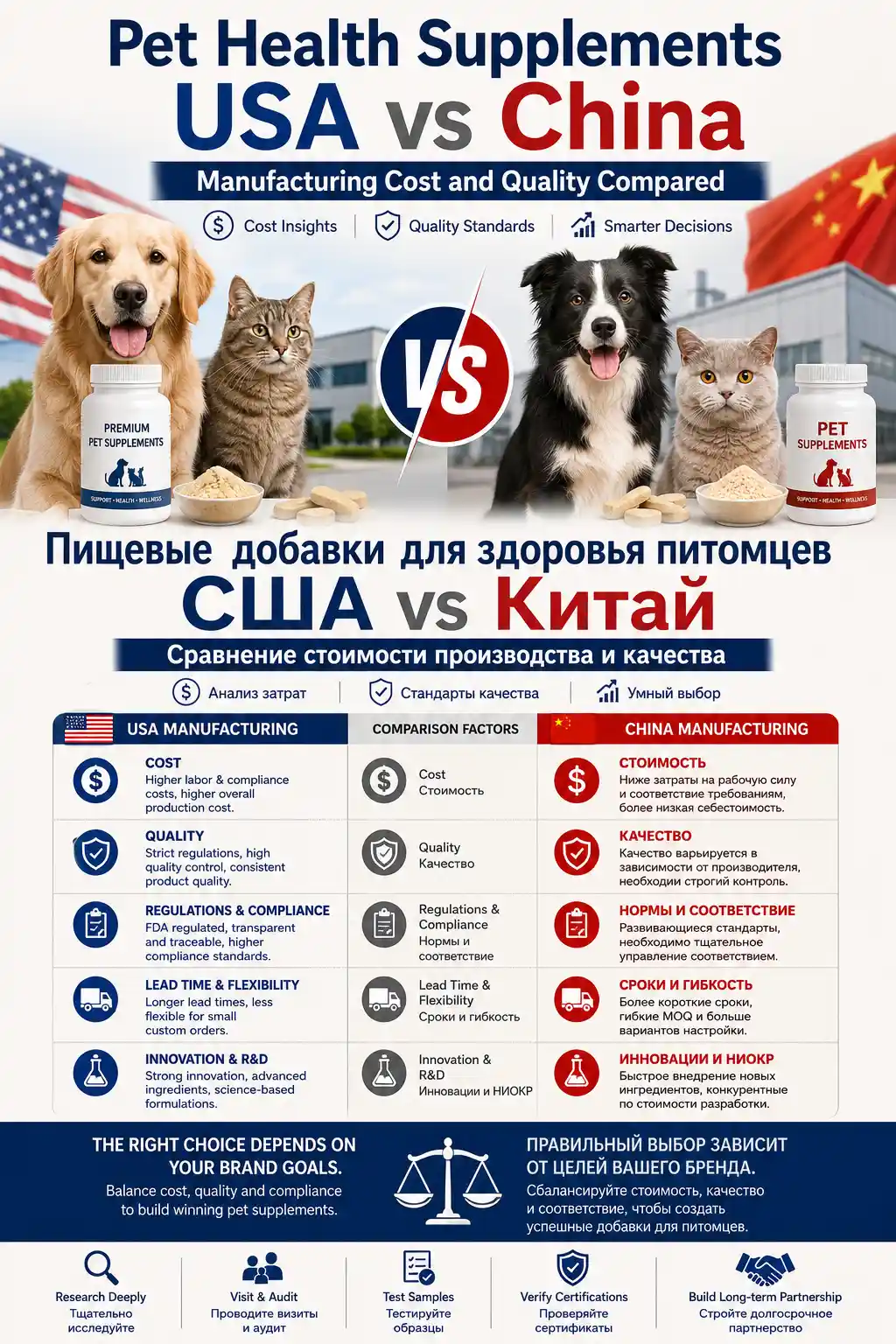
Pet Health Supplements USA vs China Manufacturing Cost and Quality Compared
If you're sourcing pet health supplements, the USA vs China question is unavoidable. American manufacturers charge more. Chinese manufacturers charge less. But the real question isn't which is cheaper — it's where you get the best value for your specific product and market.
The gap looks different once the landed cost is assembled from its parts, and narrower than most buyers assume when only the unit price is compared.
The Cost Breakdown — Where the Numbers Actually Land
Take the same powder, in the same jar, ordered at the same volume, and price it line by line instead of comparing two headline figures.
| Cost Component | What drives it in the USA | What drives it in China |
|---|---|---|
| Raw materials (per unit) | Fewer domestic producers, so the material is often bought in at world prices | Shorter distance to the producers, and more grades to choose from |
| Production and labor (per unit) | Higher wage base and stricter staffing ratios | Lower wage base; automation level is what actually separates the quotes |
| Packaging materials (per unit) | Print and bottle runs priced for the domestic market | Larger print runs available at lower unit cost |
| Quality testing (per batch) | Domestic labs, priced per test | Labs on site, so the cost is capacity rather than a purchase order |
| Ocean freight | Not applicable | Incoterms, destination port and container utilisation |
| Import duties | Not applicable | Declared value and tariff classification — the classification matters more than the invoice |
| Landed cost | The sum of the four lines above it | The sum of all six, including freight and duty |
A China-sourced unit lands lower on every line, and the total gap is real. What the spreadsheet does not carry is everything below: the certificate set, the testing depth and the recovery plan when a batch fails.
Quality Differences — What the Price Gap Actually Buys
The most common question I get is "Is Chinese quality actually worse?" The honest answer is: it depends entirely on which manufacturer you choose.
In the US, the regulatory baseline is higher. The FDA inspects pet supplement facilities, and while enforcement varies, the minimum quality floor is higher. A mid-tier US manufacturer will typically have:
- Full-time QC staff with degrees in food science or chemistry
- In-house microbiology labs
- Batch retention programs with stability chambers
- Traceable raw material sourcing with CoA documentation
In China, the range is much wider. At the top end, manufacturers serving Japanese, EU, and US export markets operate at standards equal to or exceeding US facilities — many hold FDA registration, FSSC 22000, and BRC certifications simultaneously. At the low end, facilities with minimal quality control can produce supplements at shockingly low prices, but you wouldn't want your brand name on their output.
The spread inside one country is wider than the spread between two countries. Two plants in the same province can sit further apart than a mid-tier US facility and a top-tier Chinese one, which is why the certificate set tells you more than the country name does.
Where China Manufacturing Actually Excels
China has genuine advantages beyond price. A large share of the world's vitamin C, glucosamine and omega-3 raw material is produced there, so the material travels a shorter distance to the plant. Shorter distance means less inventory in transit, fresher stock and a smaller capital requirement on the raw-material line.
For ingredients like glucosamine hydrochloride, chondroitin sulfate, and certain probiotics, a Chinese manufacturer can often offer better pricing and shorter lead times than a US manufacturer importing the same raw materials. Typical examples include joint support chews for dogs.
Where USA Manufacturing Has the Edge
US manufacturers win on
- Regulatory simplicity — no import paperwork, no customs clearance, and no foreign-facility registration file to assemble
- Faster shipping — domestic transit is measured in days, a sea crossing in weeks, and the difference sits in every reorder
- Communication — No language barriers, same time zone for customer support
- Brand perception — "Made in USA" carries a premium with certain consumer segments
The comparison is usually framed as landed cost, and landed cost is where it turns. Freight, duty, safety stock for a longer shipping lane and inventory carrying cost all sit on the China side of the ledger; the US side carries a higher unit price but shorter replenishment. Run both numbers on your own volumes before choosing.
How to Decide Which Route Is Right for You
The framework we use when scoping a project is straightforward:
Choose US manufacturing if: your brand sells on a domestic-origin claim, your runs are small enough that freight and duty would dominate the landed cost, or you need to restock faster than a sea shipment allows.
Choose Chinese manufacturing if: price per unit drives the decision, your volume is large enough to absorb a container, or your market does not reward a domestic-origin claim.
Hybrid approach: Many successful brands now split production — high-volume core SKUs in China, niche or premium lines in the US. The best of both worlds if you can manage dual supply chains. The split works where volume is high, and probiotic powder for dogs and cats is that kind of SKU.
The Bottom Line
The USA vs China decision isn't about good versus bad. It's about fit. A GMP-certified Chinese exporter with FDA registration, FSSC 22000, and a track record of export-quality production can deliver pet supplements at competitive prices without sacrificing quality. But you need to do the verification work — site audits, third-party lab testing, and reference checks — to separate the reliable facilities from the rest.
Saving money on manufacturing means nothing if the quality damages your brand. But paying more for US production doesn't automatically guarantee better quality either. The manufacturer's individual standards matter far more than which country they operate in.