
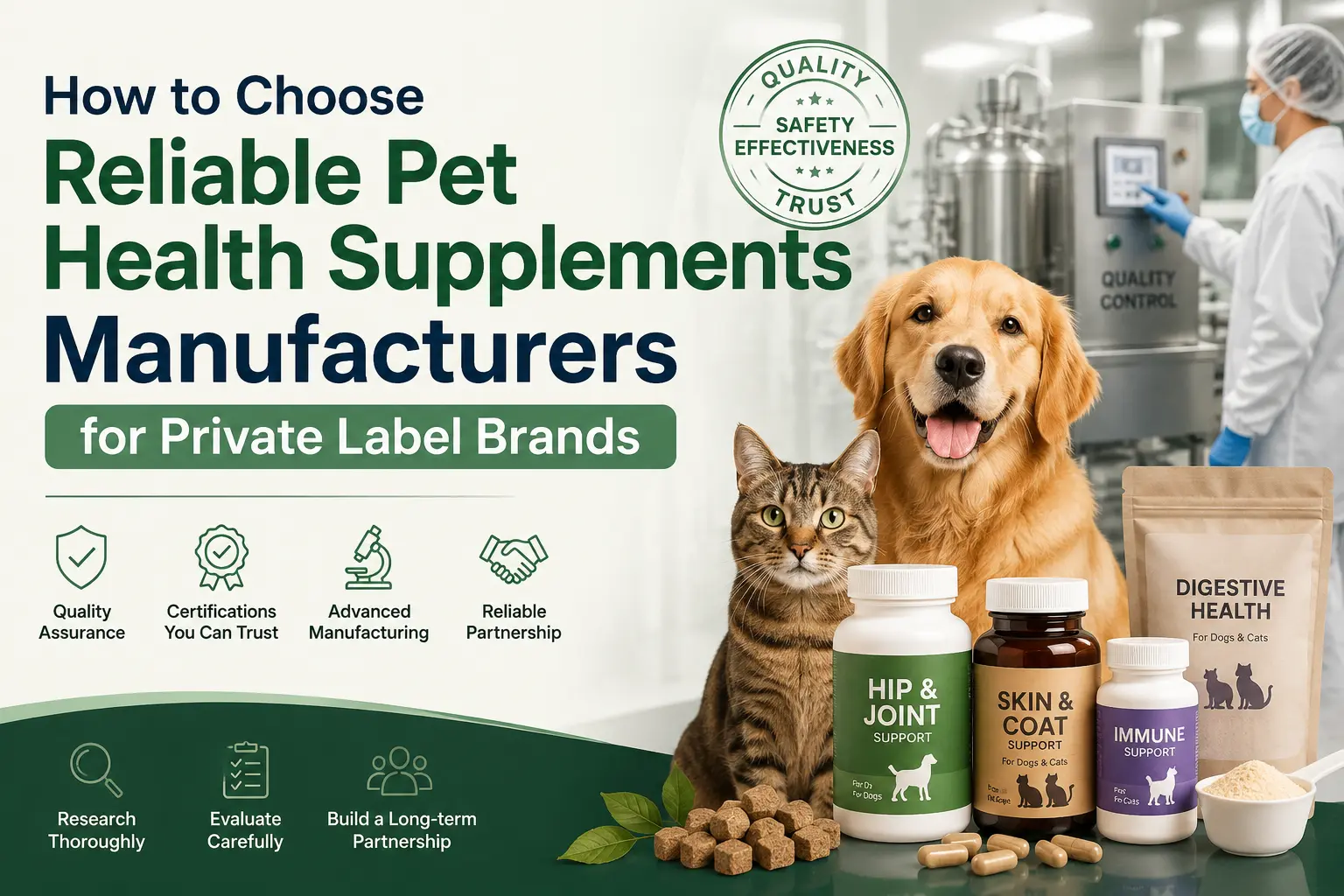
How to Choose Reliable Pet Health Supplements Manufacturers for Private Label Brands
Building a private label pet supplement brand sounds straightforward — find a manufacturer, pick a formula, slap on your logo. But after a decade in this industry, I've seen too many brands learn the hard way that not every manufacturer who looks good on paper can actually deliver.
The global pet supplements market is projected at about USD 2.8 billion in 2025, growing at a CAGR of 6.9% toward USD 4.6 billion by 2033 (Grand View Research, 2026). That growth has attracted countless new manufacturers, and separating the reliable ones from the rest takes more than a quick Google search.
What a Reliable Manufacturer Actually Looks Like
The reliable facilities share a few non-negotiable traits, and none of them shows up on a brochure.
First, they hold GMP certification (Good Manufacturing Practice) for pet supplements specifically — not just a general food certificate. In China, that means an SC food production license plus ISO 22000 or FSSC 22000. If a manufacturer can't show you these documents within five minutes of asking, that's a red flag.
Second, they maintain batch-to-batch consistency. A reliable manufacturer keeps every production batch record for at least three years and can show you stability test data. One certificate of analysis covers one lot, so ask for results from several successive batches and compare them against the same specification. A single sheet for a single lot is not a consistency record.
Ingredient Sourcing Transparency
Here's a question that separates amateurs from professionals: "Where do your raw ingredients come from?"
This is why experienced buyers do not just ask for the country of origin. They ask for the supplier name and the purity certificate. Glucosamine hydrochloride is the clearest example: the same name covers several grades, and the grade — not the flag on the invoice — is what decides how the chew behaves and what you can claim on the label.
Ask for Certificate of Analysis (CoA) for every active ingredient batch. If they hesitate, move on.
Minimum Order Quantities and Flexibility
The MOQ you are quoted follows the format and the pack, not the size of your ambition. Standard formulas here start at 100 units per SKU with a custom label and bottle, or 500 units once a printed outer carton is involved, and the price per unit steps down as the run grows.
For a new brand testing the market, look for manufacturers who will run a small trial batch before you commit to full production. This lets you validate the formula, packaging, and market response without tying up capital.
What I've seen work well is a phased approach: start with a small trial order to verify quality and delivery timelines, then scale to a full production run once you're confident.
Communication and Lead Times
This matters more than most buyers realize. A manufacturer who takes three days to reply to your inquiry during the sampling phase will take three weeks when something goes wrong during production.
Ask about their typical lead times upfront. Standard production takes 20–25 working days after the formula, artwork and deposit are confirmed. Fastest turnaround is 10–15 working days once capacity is confirmed (rush fee applies).
Also ask for a timeline breakdown: raw material procurement, production, quality testing, packaging, and shipping. A manufacturer who can't estimate each stage hasn't planned the process properly.
What Certifications Actually Matter for Export
If you're importing from China to the US or Europe, your manufacturer needs specific export certifications:
- For the US market: FDA registration and Facility Registration Number. The manufacturer should be registered with the FDA as a pet food/supplement facility.
- For the EU market: Compliance with EU Regulation 183/2005 and 1069/2009 for animal feed.
- General: Third-party laboratory testing reports, preferably from SGS, Eurofins, or Intertek.
Expired documents are the common failure, and they are easy to miss because the certificate looks right. A registration that lapsed and a certificate that was never issued produce the same screenshot, which is why the check has to run against the issuing body rather than against the file.
The Bottom Line
Choosing a reliable pet health supplements manufacturer comes down to three things: verified certifications, transparent sourcing, and clear communication. Start with a small trial order, test the product yourself before committing to volume, and always — always — verify claims with documentation.
The right manufacturer is a long-term partner, not just a supplier. Choose one who treats quality as a baseline, not a selling point.