
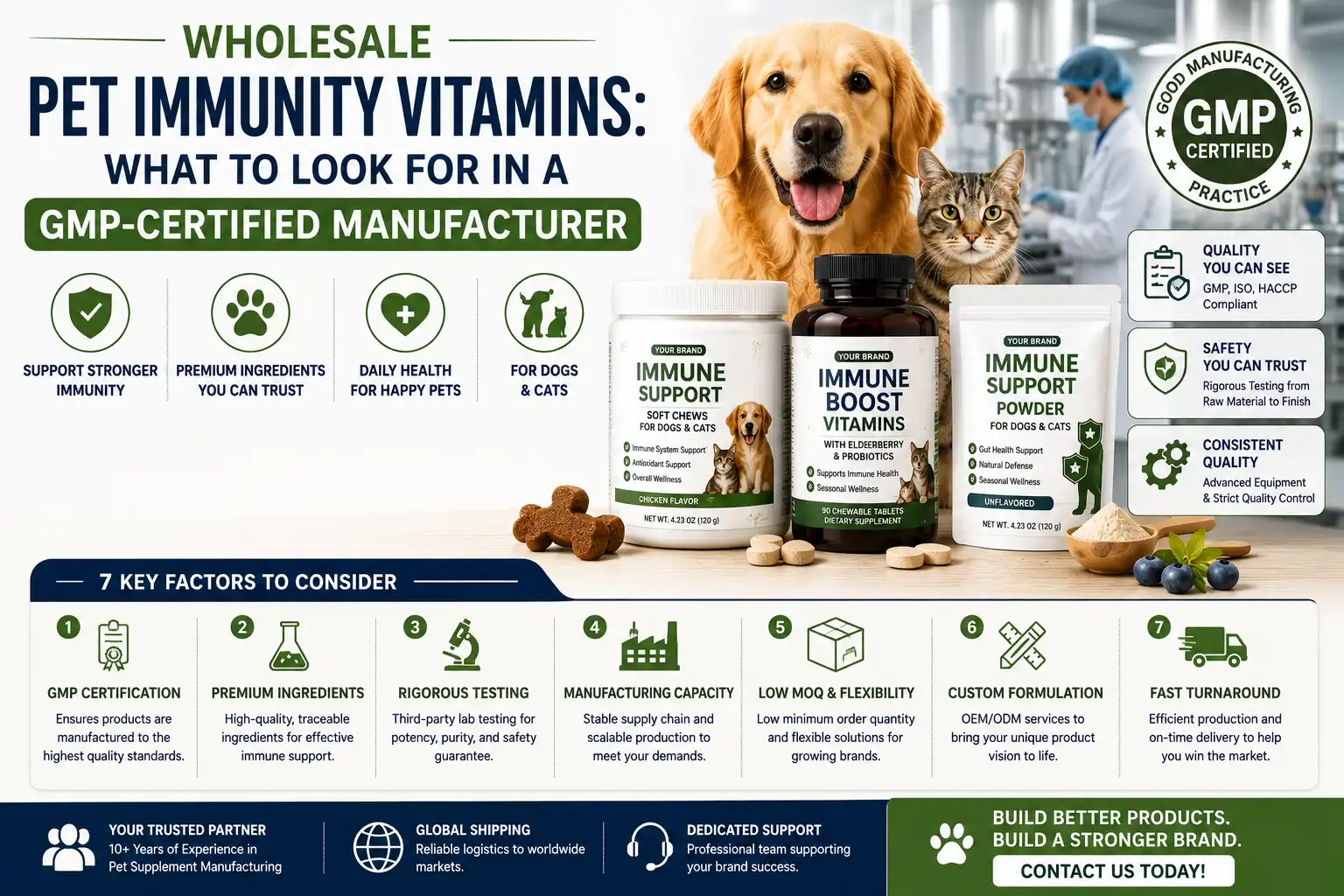
Wholesale Pet Immunity Vitamins: What to Look for in a GMP-Certified Manufacturer
Quick Answer (Featured Snippet Optimized)
What should I look for in a GMP-certified pet supplement manufacturer? A quality GMP-certified manufacturer should have: 1) Current GMP certification (verified with certifying body), 2) FDA registration (for US market), 3) Third-party testing with Certificates of Analysis (COA), 4) Documented quality procedures, 5) Traceability systems, and 6) Clean, well-maintained facility. Additionally, look for NASC Quality Seal certification and request facility tours, client references, and sample products before committing. Learn the 7 key factors for evaluating manufacturers.
Introduction: Why GMP Certification Matters for Wholesale Pet Supplements
When sourcing wholesale pet immunity vitamins, GMP (Good Manufacturing Practices) certification is the foundation of product quality and safety. However, not all GMP certifications are created equal, and certification alone doesn't guarantee excellence.
As you evaluate potential manufacturing partners, understanding what separates exceptional GMP-certified manufacturers from mediocre ones is critical to protecting your brand, serving customers effectively, and ensuring regulatory compliance.
This guide provides a comprehensive framework for evaluating GMP-certified manufacturers, helping you identify partners that deliver consistent quality, safety, and reliability.
Understanding GMP Certification for Pet Supplements
What is GMP?
Good Manufacturing Practices (GMP) is a system of guidelines and regulations that ensures products are consistently produced and controlled according to quality standards. For pet supplements, GMP covers every aspect of manufacturing:
Core GMP Principles:
| Principle | What It Means | Why It Matters |
|-----------|---------------|----------------|
| Facility Design | Proper layout to prevent contamination | Ensures product safety |
| Equipment | Appropriate, well-maintained machinery | Consistent production quality |
| Personnel | Trained staff following standard procedures | Reduces human error |
| Documentation | Complete records of all processes | Enables traceability |
| Quality Control | Testing at every production stage | Verifies product quality |
| Sanitation | Clean, hygienic manufacturing environment | Prevents contamination |
Why GMP Matters for Pet Supplements
Product Safety:
- Prevents contamination with harmful substances
- Ensures ingredients are safe for pets
- Protects against microbiological hazards
- Controls heavy metal and chemical contamination
Product Consistency:
- Guarantees every batch meets specifications
- Ensures accurate ingredient levels
- Maintains potency throughout shelf life
- Delivers reliable results for pets
Regulatory Compliance:
- Meets FDA requirements (21 CFR Part 111)
- Satisfies international regulatory standards
- Enables legal sale in target markets
- Protects against regulatory action
Brand Protection:
- Reduces risk of product recalls
- Prevents reputation damage
- Builds customer trust and loyalty
- Supports premium positioning
Business Success:
- Enables access to retail channels
- Supports insurance coverage
- Facilitates international expansion
- Attracts quality-conscious customers
GMP vs. Other Certifications
| Certification | Focus | Scope | Importance |
|--------------|-------|-------|------------|
| GMP | Manufacturing processes | Production facilities | Critical - Foundation of quality |
| FDA Registration | US market compliance | US facilities | Essential for US sales |
| NASC Quality Seal | Animal supplement standards | NASC members | Highly recommended |
| ISO 22000 | Food safety management | Global recognition | International credibility |
| SQF | Food safety and quality | GFSI benchmarked | Retail acceptance |
Key Insight: GMP is the minimum standard. Look for manufacturers that go beyond basic GMP with additional certifications like NASC Quality Seal and ISO 22000.
Related Reading: Learn about all the certifications you should look for in a pet supplement manufacturer.
Key GMP Certifications to Verify
1. FDA Registration (United States)
What It Means:
- Facility registered with FDA
- Subject to FDA inspections
- Complies with 21 CFR Part 111 (Dietary Supplements)
- Meets Current Good Manufacturing Practice (cGMP) requirements
What to Verify:
- FDA registration number (valid and current)
- Inspection history (no warning letters)
- Compliance with 21 CFR Part 111
- Corrective action procedures for any issues
How to Verify:
1. Request FDA registration confirmation
2. Check FDA Facility Registration Database
3. Review inspection history (public records)
4. Ask for copies of any FDA correspondence
Red Flags:
- No FDA registration number
- History of FDA warning letters
- Refusal to share registration information
- Recent inspection failures
Why It Matters: FDA registration is mandatory for facilities manufacturing products for the US market. Non-registered facilities cannot legally produce supplements for US sale.
2. NASC Quality Seal (National Animal Supplement Council)
What It Means:
- Industry-specific certification for animal supplements
- Rigorous quality standards beyond basic GMP
- Adverse event reporting system
- Regular facility audits by NASC
- Commitment to industry best practices
Requirements:
- GMP compliance (verified)
- Product testing protocols (documented)
- Label compliance (reviewed)
- Quality control documentation (comprehensive)
- Adverse event monitoring (active)
- Corrective action procedures (documented)
- Annual facility audits (NASC-conducted)
Benefits of NASC Certification:
- Industry Recognition: Demonstrates commitment to animal supplement quality
- Consumer Trust: NASC Quality Seal recognized by pet owners
- Retail Acceptance: Preferred by major retailers
- Regulatory Support: NASC advocates for member companies
- Continuous Improvement: Regular audits drive quality enhancement
How to Verify:
1. Check NASC member directory (public)
2. Request NASC Quality Seal certificate
3. Review audit reports (if shared)
4. Verify membership status directly with NASC
Red Flags:
- Not an NASC member
- Expired NASC membership
- History of NASC audit failures
- Reluctance to share NASC information
Pro Tip: NASC certification is particularly valuable for brands targeting health-conscious pet owners and premium retail channels.
3. ISO 22000 / FSSC 22000 (Food Safety Management)
What It Means:
- International food safety management standard
- Comprehensive hazard analysis (HACCP-based)
- Risk-based quality management
- Global recognition across industries
- Systematic approach to food safety
Key Components:
- Interactive Communication: Internal and external stakeholders
- System Management: Documented processes and procedures
- Prerequisite Programs: Basic conditions for食品安全
- HACCP Principles: Hazard analysis and critical control points
Benefits:
- International credibility
- Systematic approach to食品安全
- Risk-based thinking
- Continuous improvement framework
- Recognition by global retailers
How to Verify:
1. Request ISO certificate (current and valid)
2. Check certifying body accreditation (IAF MLA signatory)
3. Review scope of certification (should include pet supplements)
4. Verify certificate number with certifying body
Red Flags:
- Expired ISO certificate
- Certifying body not accredited
- Scope doesn't include pet supplements
- Unable to provide certificate
4. SQF (Safe Quality Food) Certification
What It Means:
- Rigorous food safety and quality program
- Recognized by Global Food Safety Initiative (GFSI)
- Three levels of certification
- Comprehensive approach to食品安全
Certification Levels:
| Level | Focus | Requirements |
|-------|-------|--------------|
| Level 1 | Food Safety Fundamentals | Basic食品安全 practices |
| Level 2 | Food Safety Plan (HACCP) | HACCP implementation |
| Level 3 | Food Quality Plan | Quality management system |
Benefits:
- GFSI benchmarked (global recognition)
- Preferred by major retailers
- Comprehensive approach
- Continuous improvement
How to Verify:
1. Check SQF certified supplier database (public)
2. Request SQF certificate
3. Review audit scores (if shared)
4. Verify certification level
Red Flags:
- Not SQF certified
- Low audit scores
- Expired certification
- Level 1 only (basic)
5. Organic / Non-GMO Certifications
What They Mean:
- USDA Organic: Ingredients grown without synthetic pesticides/fertilizers
- Non-GMO Project Verified: No genetically modified organisms
- EU Organic: Meets European organic standards
- Canadian Organic: Meets Canadian organic standards
Benefits:
- Market differentiation
- Premium positioning
- Consumer trust
- Regulatory compliance for organic claims
How to Verify:
1. Check certifying body databases (USDA, Non-GMO Project)
2. Request organic certificates
3. Review ingredient documentation
4. Verify scope of certification
Considerations:
- Organic ingredients cost more
- Supply chain may be limited
- Certification requirements vary by market
- Labeling rules are specific
Pro Tip: Organic and non-GMO certifications are valuable for brands targeting health-conscious consumers, but ensure your manufacturer can reliably source certified ingredients.
Evaluating GMP Compliance: 10 Critical Areas
1. Facility Design and Maintenance
What to Look For:
Physical Layout:
- ✅ Proper flow to prevent cross-contamination (raw → processed → packaged)
- ✅ Separate areas for different production stages
- ✅ Adequate space for equipment and personnel
- ✅ Controlled access to production areas
- ✅ Designated areas for cleaning and sanitation
Environmental Controls:
- ✅ Temperature monitoring and control
- ✅ Humidity monitoring and control
- ✅ Air filtration systems (HEPA filters)
- ✅ Positive air pressure in production areas
- ✅ Pest control systems
Maintenance:
- ✅ Preventive maintenance schedules (documented)
- ✅ Equipment calibration records
- ✅ Facility repair and upkeep logs
- ✅ Cleaning validation procedures
Questions to Ask:
1. Can you provide a facility floor plan?
2. What is your preventive maintenance schedule?
3. How do you prevent cross-contamination?
4. What environmental controls are in place?
5. How often is equipment calibrated?
Red Flags:
- ❌ Cluttered or disorganized facility
- ❌ No environmental monitoring
- ❌ Visible pest issues
- ❌ Deferred maintenance
- ❌ No documented maintenance schedules
Due Diligence:
- Request virtual facility tour
- Ask for maintenance records
- Verify environmental monitoring data
- Check equipment age and condition
2. Equipment and Calibration
What to Look For:
Equipment Condition:
- ✅ Appropriate equipment for product type
- ✅ Modern, well-maintained machinery
- ✅ Proper installation and qualification
- ✅ Adequate capacity for production needs
- ✅ Backup equipment for critical processes
Calibration and Maintenance:
- ✅ Regular calibration schedules (documented)
- ✅ Calibration records for all critical equipment
- ✅ Preventive maintenance programs
- ✅ Equipment cleaning procedures
- ✅ Validation documentation (IQ/OQ/PQ)
Questions to Ask:
1. What equipment do you use for production?
2. How often is equipment calibrated?
3. Can you provide maintenance records?
4. What is your equipment cleaning procedure?
5. Do you have backup equipment for critical processes?
Red Flags:
- ❌ Outdated or poorly maintained equipment
- ❌ No calibration records
- ❌ Inadequate cleaning procedures
- ❌ No preventive maintenance program
- ❌ Equipment frequently breaks down
Due Diligence:
- Request equipment list with ages
- Ask for calibration certificates
- Review maintenance logs
- Observe equipment condition during facility tour
3. Raw Material Control
What to Look For:
Supplier Qualification:
- ✅ Approved supplier qualification program
- ✅ Supplier audit records
- ✅ Supplier agreements and specifications
- ✅ Regular supplier performance reviews
- ✅ Backup suppliers for critical ingredients
Incoming Material Testing:
- ✅ Identity testing (confirm correct ingredient)
- ✅ Purity analysis (heavy metals, contaminants)
- ✅ Potency testing (active ingredient levels)
- ✅ Microbiological testing (bacteria, mold)
- ✅ Allergen testing (if applicable)
Traceability:
- ✅ Batch-level tracking from raw material to finished product
- ✅ Certificate of Analysis (COA) for every batch
- ✅ Ingredient lot numbers recorded
- ✅ Complete chain of custody documentation
Storage:
- ✅ Proper storage conditions (temperature, humidity)
- ✅ FIFO (First In, First Out) procedures
- ✅ Segregation of different materials
- ✅ Protection from contamination
Questions to Ask:
1. How do you qualify raw material suppliers?
2. What testing do you perform on incoming materials?
3. Can you provide COAs for all ingredients?
4. How do you ensure ingredient traceability?
5. What are your storage conditions?
Red Flags:
- ❌ No supplier qualification program
- ❌ Skipping incoming material testing
- ❌ Missing or incomplete COAs
- ❌ Poor storage conditions
- ❌ No traceability system
Due Diligence:
- Request supplier qualification documentation
- Ask for sample COAs
- Review incoming inspection procedures
- Verify storage conditions during tour
Related Reading: Understand ingredient sourcing best practices in our manufacturer evaluation guide.
4. Production Process Controls
What to Look For:
Standard Operating Procedures (SOPs):
- ✅ Written SOPs for all critical processes
- ✅ SOPs reviewed and approved
- ✅ Staff trained on SOPs
- ✅ SOPs readily accessible to production staff
- ✅ Regular SOP reviews and updates
Batch Production Records:
- ✅ Complete batch records for every production run
- ✅ All critical parameters documented
- ✅ In-process test results recorded
- ✅ Deviations documented and investigated
- ✅ Batch records reviewed and approved
In-Process Quality Checks:
- ✅ Weight checks (tablets, capsules)
- ✅ Hardness testing (tablets)
- ✅ Thickness measurements (tablets)
- ✅ Disintegration testing
- ✅ Visual inspection
Environmental Monitoring:
- ✅ Temperature monitoring during production
- ✅ Humidity monitoring
- ✅ Air quality monitoring
- ✅ Cleaning verification between batches
Questions to Ask:
1. Can you provide SOPs for key processes?
2. What in-process tests do you perform?
3. How do you ensure batch-to-batch consistency?
4. What is your cleaning validation process?
5. How do you document production deviations?
Red Flags:
- ❌ No documented SOPs
- ❌ Incomplete batch records
- ❌ Skipping in-process testing
- ❌ No environmental monitoring
- ❌ Poor documentation practices
Due Diligence:
- Request sample SOPs and batch records
- Review in-process testing procedures
- Ask for deviation investigation examples
- Verify documentation practices during tour
5. Quality Control Testing
What to Look For:
Finished Product Testing:
| Test Type | Purpose | Acceptance Criteria |
|-----------|---------|---------------------|
| Potency | Verify active ingredient levels | 90-110% of label claim |
| Microbiological | Check for harmful bacteria | Total aerobic count <1000 CFU/g |
| Heavy Metals | Test for lead, mercury, arsenic, cadmium | Below regulatory limits |
| Pesticides | Screen for chemical residues | Below detection limits |
| Stability | Validate shelf life | Maintains potency through expiry |
Testing Protocols:
- ✅ Testing performed on every batch
- ✅ Third-party laboratory verification
- ✅ Complete Certificates of Analysis (COA)
- ✅ Out-of-specification investigation procedures
- ✅ Retention sample program
Stability Testing:
- ✅ Ongoing stability studies
- ✅ Real-time and accelerated stability data
- ✅ Shelf life validation
- ✅ Storage condition recommendations
Questions to Ask:
1. What finished product tests do you perform?
2. Do you use third-party laboratories?
3. Can you provide Certificates of Analysis?
4. What is your stability testing protocol?
5. How do you handle out-of-specification results?
Red Flags:
- ❌ No finished product testing
- ❌ In-house testing only (no third-party verification)
- ❌ Missing COAs
- ❌ No stability data
- ❌ Out-of-specification results not investigated
Due Diligence:
- Request sample COAs
- Ask for stability study data
- Verify third-party lab accreditation
- Review out-of-specification investigation procedures
Pro Tip: Always request COAs for products you're considering purchasing. Legitimate manufacturers provide these readily.
Related Reading: Learn what to look for in GMP-certified manufacturers for comprehensive evaluation.
6. Personnel and Training
What to Look For:
Training Programs:
- ✅ Documented training programs for all staff
- ✅ Training on GMP and quality procedures
- ✅ Job-specific training for production roles
- ✅ Regular training updates and refresher courses
- ✅ Training effectiveness assessments
Personnel Qualifications:
- ✅ Qualified staff for critical positions
- ✅ Experience in supplement manufacturing
- ✅ Understanding of GMP requirements
- ✅ Commitment to quality and safety
Hygiene Requirements:
- ✅ Personal hygiene policies (handwashing, protective clothing)
- ✅ Health monitoring programs
- ✅ Illness reporting procedures
- ✅ Visitor and contractor policies
Questions to Ask:
1. What training do production staff receive?
2. How often is training updated?
3. What hygiene requirements are in place?
4. Do you have a health monitoring program?
5. How do you assess training effectiveness?
Red Flags:
- ❌ No formal training program
- ❌ High staff turnover
- ❌ Inadequate hygiene practices
- ❌ No training records
- ❌ Unqualified staff in critical roles
Due Diligence:
- Request training program documentation
- Ask for training records (sample)
- Review hygiene policies
- Observe staff practices during tour
7. Documentation and Record Keeping
What to Look For:
Documentation Systems:
- ✅ Document control system (creation, review, approval, revision)
- ✅ Standardized forms and records
- ✅ Electronic or paper-based systems with backups
- ✅ Access controls and security
- ✅ Regular document reviews
Record Types:
- ✅ Batch production records (complete, accurate)
- ✅ Quality control test results
- ✅ Equipment maintenance and calibration logs
- ✅ Training records
- ✅ Deviation and CAPA reports
- ✅ Supplier qualification records
- ✅ Customer complaint records
Record Retention:
- ✅ Defined retention periods (typically 1-3 years minimum)
- ✅ Secure storage (physical or electronic)
- ✅ Easy retrieval when needed
- ✅ Protection from damage or loss
Questions to Ask:
1. How long do you retain records?
2. Can you provide batch records for specific products?
3. What is your document control system?
4. How do you handle deviations?
5. How are records protected from loss or damage?
Red Flags:
- ❌ Incomplete or missing records
- ❌ No document control system
- ❌ Unable to provide historical records
- ❌ Poor record-keeping practices
- ❌ No backup systems
Due Diligence:
- Request sample batch records
- Review document control procedures
- Ask for record retention policies
- Verify backup systems
8. Sanitation and Hygiene
What to Look For:
Sanitation Procedures:
- ✅ Written sanitation procedures (SOPs)
- ✅ Regular cleaning schedules (daily, weekly, monthly)
- ✅ Sanitation verification testing (environmental monitoring)
- ✅ Cleaning validation for critical equipment
- ✅ Sanitation records
Pest Control:
- ✅ Integrated pest management program
- ✅ Regular pest control services
- ✅ Pest monitoring and documentation
- ✅ Preventive measures (sealing entry points)
- ✅ Pest control records
Waste Management:
- ✅ Waste handling procedures
- ✅ Proper waste disposal
- ✅ Waste segregation (production, chemical, general)
- ✅ Waste records
Questions to Ask:
1. What are your sanitation procedures?
2. How do you verify cleaning effectiveness?
3. What pest control measures are in place?
4. How do you manage production waste?
5. Can you provide sanitation records?
Red Flags:
- ❌ No written sanitation procedures
- ❌ Visible cleanliness issues
- ❌ Pest problems
- ❌ No sanitation verification
- ❌ Poor waste management
Due Diligence:
- Observe facility cleanliness during tour
- Request sanitation SOPs
- Review pest control records
- Ask for sanitation verification data
9. Recall and Complaint Handling
What to Look For:
Recall Procedures:
- ✅ Written recall procedure
- ✅ Recall team with defined roles
- ✅ Mock recall testing (at least annually)
- ✅ Communication templates
- ✅ Distribution traceability system
Complaint Handling:
- ✅ Complaint handling system (receipt, investigation, response)
- ✅ Complaint tracking and trending
- ✅ Root cause analysis for significant complaints
- ✅ Corrective actions for systemic issues
- ✅ Customer communication procedures
Adverse Event Reporting:
- ✅ Adverse event monitoring (if required)
- ✅ Reporting procedures (FDA, NASC)
- ✅ Investigation and documentation
- ✅ Corrective actions
CAPA System (Corrective and Preventive Action):
- ✅ Formal CAPA procedure
- ✅ Root cause analysis methodology
- ✅ Corrective action implementation
- ✅ Effectiveness verification
- ✅ CAPA tracking and trending
Questions to Ask:
1. Do you have a recall procedure?
2. When was your last mock recall?
3. How do you handle customer complaints?
4. What is your CAPA process?
5. Can you provide examples of CAPAs?
Red Flags:
- ❌ No recall procedure
- ❌ Never conducted mock recall
- ❌ Poor complaint handling
- ❌ No CAPA system
- ❌ Recurring quality issues
Due Diligence:
- Request recall procedure (review)
- Ask for mock recall results
- Review complaint handling examples
- Ask for CAPA examples
10. Continuous Improvement
What to Look For:
Internal Audits:
- ✅ Regular internal audit program (at least annually)
- ✅ Trained internal auditors
- ✅ Audit findings tracked and resolved
- ✅ Audit reports documented
Management Review:
- ✅ Regular management review meetings (at least annually)
- ✅ Review of quality metrics and trends
- ✅ Resource allocation for quality improvements
- ✅ Strategic quality planning
Trend Analysis:
- ✅ Tracking of quality metrics (deviations, complaints, returns)
- ✅ Trend analysis of quality data
- ✅ Identification of improvement opportunities
- ✅ Benchmarking against industry standards
Industry Engagement:
- ✅ Membership in industry associations (NASC, etc.)
- ✅ Attendance at industry conferences
- ✅ Adoption of industry best practices
- ✅ Continuous learning and improvement culture
Questions to Ask:
1. How often do you conduct internal audits?
2. What continuous improvement initiatives are in place?
3. How do you track and trend quality metrics?
4. What industry associations do you participate in?
5. Can you provide examples of recent improvements?
Red Flags:
- ❌ No internal audit program
- ❌ Resistance to change
- ❌ Lack of quality metrics
- ❌ No management review
- ❌ Isolated from industry developments
Due Diligence:
- Ask for internal audit schedule and results
- Review management review minutes
- Request quality metric reports
- Ask for improvement examples
Due Diligence Checklist: Complete Evaluation Guide
Before Ordering:
Certification Verification:
- [ ] GMP certificate (current, verified with certifying body)
- [ ] FDA registration confirmation (for US market)
- [ ] NASC Quality Seal certificate (if applicable)
- [ ] ISO/SQF certificates (if applicable)
- [ ] Organic/Non-GMO certificates (if applicable)
Documentation Review:
- [ ] Sample Certificate of Analysis (COA)
- [ ] Stability data summary
- [ ] Client references (3-5 contacts)
- [ ] Insurance certificates
- [ ] Quality manual or quality policy
Facility Assessment:
- [ ] Virtual or in-person facility tour
- [ ] Equipment condition observation
- [ ] Cleanliness and organization
- [ ] Environmental controls
- [ ] Staff practices
Sample Evaluation:
- [ ] Product samples ordered
- [ ] Quality assessment of samples
- [ ] Palatability testing (if applicable)
- [ ] Packaging evaluation
Questions to Ask References:
1. How long have you worked with this manufacturer?
2. What products do they manufacture for you?
3. How would you rate their quality consistency?
4. How responsive are they to issues?
5. Have you experienced any quality problems?
6. Would you recommend them? Why or why not?
7. What is their communication like?
8. How do they handle problems or delays?
Documentation to Request:
| Document | Purpose | When to Request |
|----------|---------|-----------------|
| GMP Certificate | Verify certification | Initial inquiry |
| FDA Registration | Confirm compliance | Initial inquiry |
| Sample COA | Assess testing quality | Quote stage |
| Stability Data | Verify shelf life | Before ordering |
| Client References | Check reputation | Before ordering |
| Insurance Certificate | Verify coverage | Before ordering |
| Quality Manual | Understand systems | Due diligence |
Red Flags Summary: Warning Signs to Watch For
Immediate Disqualifiers:
❌ No GMP Certification
- Cannot legally manufacture supplements
- No quality assurance
- Regulatory risk for your brand
❌ Refusal to Provide Documentation
- Lack of transparency
- May hide quality issues
- Unprofessional business practice
❌ History of FDA Warning Letters
- Compliance problems
- Quality system failures
- Risk of future issues
❌ Unable to Provide COAs
- No quality testing
- Cannot verify product quality
- Regulatory non-compliance
❌ No Third-Party Testing
- Self-reported quality only
- No independent verification
- Potential bias in results
Serious Concerns:
⚠️ Outdated Certifications
- May not reflect current quality
- Could indicate neglect
- Verification needed
⚠️ Poor Communication
- Predicts future problems
- Risk of production errors
- May indicate disorganization
⚠️ Unrealistic Pricing
- May indicate inferior ingredients
- Could signal skipped testing
- Hidden costs likely
⚠️ No Recall Procedure
- Unable to handle crises
- Regulatory non-compliance
- Risk to your brand
⚠️ High Staff Turnover
- Training and knowledge loss
- Inconsistent quality
- May indicate management issues
Minor Issues (Proceed with Caution):
⚡ Limited Product Range
- May lack expertise in your category
- Could indicate specialization
- Verify relevant experience
⚡ Higher MOQ Requirements
- May not fit your budget
- Could indicate inflexibility
- Negotiate if possible
⚡ Longer Lead Times
- May delay your launch
- Could indicate capacity issues
- Plan accordingly
⚡ Limited Customization
- May not meet your needs
- Could indicate lack of R&D
- Consider alternatives
Cost vs. Quality: Understanding the True Investment
The True Cost of Low Quality:
| Issue | Impact | Estimated Cost |
|-------|--------|----------------|
| Product Recall | Reputation damage, legal fees, lost sales | $50,000 - $500,000+ |
| Customer Complaints | Lost customers, support costs, refunds | $5,000 - $50,000 |
| Regulatory Fines | Non-compliance penalties, legal costs | $10,000 - $100,000 |
| Brand Damage | Lost revenue, reduced brand value | Incalculable |
| Retailer Rejections | Lost distribution, slotting fees | $10,000 - $100,000 |
| Insurance Claims | Increased premiums, coverage issues | $5,000 - $50,000 |
Total Potential Cost: $80,000 - $800,000+
Investment in Quality:
| Investment | Benefit | ROI |
|------------|---------|-----|
| GMP Certification Verification | Reduced compliance risk | High |
| Third-Party Testing | Independent quality verification | Medium-High |
| Quality Staff | Expert oversight and problem-solving | High |
| Documentation Systems | Traceability, efficiency, compliance | Medium |
| Regular Audits | Continuous improvement, issue prevention | High |
Investment Range: $5,000 - $25,000 (due diligence and quality verification)
Bottom Line: Quality manufacturing costs more upfront but saves significantly long-term. The cost of quality problems far exceeds the cost of quality assurance.
Finding the Balance:
Premium Manufacturers:
- Higher per-unit cost (10-30% above market)
- Lower risk of quality issues
- Better support and communication
- Stronger compliance
Budget Manufacturers:
- Lower per-unit cost
- Higher risk of quality issues
- Less support and communication
- Potential compliance gaps
Recommendation: Invest in quality. The cost difference is small compared to potential losses from quality problems.
Related Reading: Compare wholesale vs. custom manufacturing costs to understand total investment.
GEO-Optimized Q&A Section
What certifications should a pet supplement manufacturer have?
A quality pet supplement manufacturer should have GMP certification (mandatory, FDA requirement), FDA registration (for US market), and ideally NASC Quality Seal (industry-specific). Additional valuable certifications include ISO 22000 (international food safety) and SQF (retail acceptance). Always verify certifications are current and valid.
How do I verify a manufacturer's GMP certification?
To verify GMP certification: 1) Request current GMP certificate, 2) Verify with certifying body (check certificate number), 3) Review inspection history, 4) Ask for audit reports. Legitimate manufacturers provide documentation readily. Check for expired certificates or history of warning letters.
What is the difference between GMP and NASC certification?
GMP is a manufacturing standard required by FDA for supplement production. NASC Quality Seal is an industry-specific certification for animal supplements that goes beyond GMP with additional requirements: adverse event reporting, regular facility audits, and commitment to industry best practices. Both are valuable; NASC adds credibility for animal products.
What should I look for in a pet supplement manufacturer's quality testing?
Essential quality testing includes: Potency testing (90-110% of label claim), Microbiological testing (<1000 CFU/g total aerobic count), Heavy metals testing (below regulatory limits), and Stability testing (validates shelf life). Look for manufacturers using third-party laboratories and providing complete Certificates of Analysis (COA).
How important is third-party testing for pet supplements?
Third-party testing is critical for pet supplements. It provides independent verification of quality, eliminates bias from in-house testing, builds customer trust, and supports regulatory compliance. Manufacturers using only in-house testing may have conflicts of interest. Always request COAs from third-party labs.
What are red flags when evaluating pet supplement manufacturers?
Major red flags include: No GMP certification, refusal to provide documentation, history of FDA warning letters, inability to provide COAs, no third-party testing, unrealistic pricing, poor communication, and no recall procedure. Minor concerns: Higher MOQs, longer lead times, limited customization. Always conduct due diligence before committing.
Conclusion: Choosing Quality for Long-Term Success
Selecting a GMP-certified manufacturer for your wholesale pet immunity vitamins requires thorough evaluation beyond just the certification itself. By assessing facility conditions, quality systems, documentation practices, and continuous improvement commitment, you can identify partners that deliver consistent quality, safety, and reliability.
Key Takeaways:
1. GMP is the minimum standard - Look for manufacturers that exceed basic requirements
2. Verify everything - Request documentation, check references, order samples
3. Quality costs less long-term - Investment in quality prevents costly problems
4. Build relationships - The best partnerships are built on trust and transparency
5. Continuous improvement matters - Choose manufacturers committed to getting better
Next Steps:
1. Use the due diligence checklist to evaluate potential partners
2. Request documentation and verify certifications
3. Order samples to assess quality
4. Check references thoroughly
5. Start with small orders before committing
Ready to find a quality manufacturer? Explore our comprehensive manufacturer evaluation guide or contact our team for personalized recommendations.
Related Articles
Essential Reading for Pet Supplement Buyers:
- How to Find a Reliable Pet Immunity Health Vitamin Manufacturer: 7 Key Factors — comprehensive manufacturer evaluation guide
- 2026 Guide: Top Pet Immunity Vitamin Manufacturers with Low MOQ — top manufacturers with low MOQ
- Pet Immune Health Supplement OEM: From Formula to Shelf — OEM process from formula to shelf