
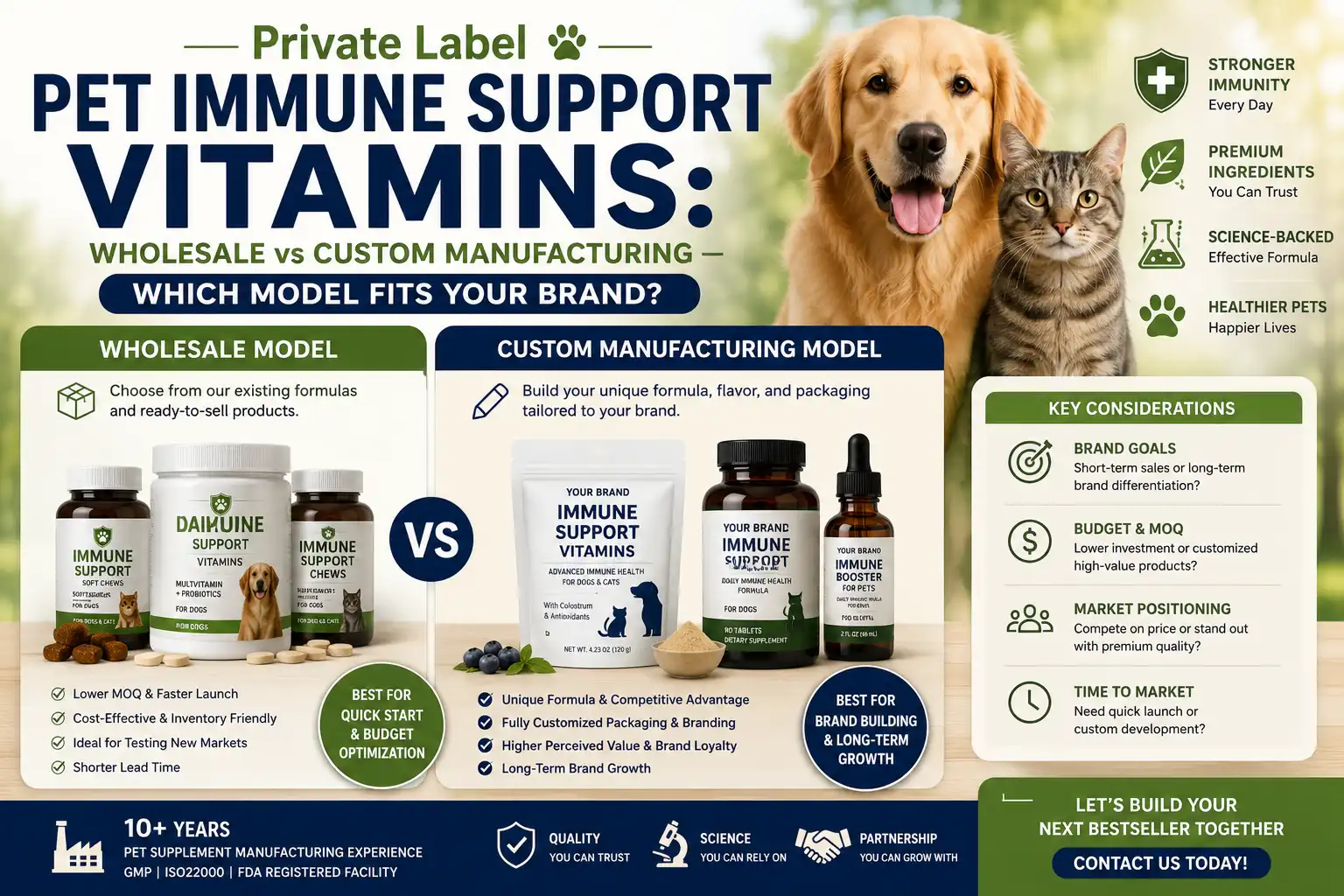
Private Label Pet Immune Support Vitamins: Wholesale vs Custom Manufacturing — Which Model Fits Your Brand?
Quick Answer (Featured Snippet Optimized)
What's the difference between wholesale and custom pet supplement manufacturing? Wholesale involves purchasing pre-formulated, ready-to-label products with low MOQs (500-2,000 units) and fast turnaround (2-4 weeks). Custom manufacturing creates unique formulations tailored to your brand with higher MOQs (2,000-10,000+ units) and longer timelines (8-16 weeks). Wholesale is ideal for market testing and quick launches; custom manufacturing suits established brands seeking differentiation.
Introduction: Choosing Your Manufacturing Path
When launching a private label pet immune support vitamin brand, your first major decision is choosing between wholesale and custom manufacturing. This choice impacts your startup costs, time-to-market, product differentiation, and long-term brand positioning.
As you evaluate potential manufacturing partners, understanding these two models helps you align your business strategy with the right production approach. This guide breaks down both options to help you make an informed decision.
Understanding the Two Manufacturing Models
Wholesale Manufacturing (Stock Products)
Definition: Purchasing pre-formulated, ready-to-label products from a manufacturer's existing catalog and selling them under your brand name.
How It Works:
1. Browse manufacturer's product catalog
2. Select products that match your market needs
3. Customize labels with your branding
4. Place order (typically 500-2,000 units minimum)
5. Receive finished products in 2-4 weeks
Best For:
- New brands testing market demand
- Retailers adding supplements to existing inventory
- Businesses with limited startup capital ($5,000-$20,000)
- Quick market entry to capitalize on trends
- Brands prioritizing speed over uniqueness
Key Characteristics:
| Aspect | Details |
|--------|---------|
| MOQ | 500 - 2,000 units |
| Timeline | 2 - 4 weeks |
| Initial Investment | $5,000 - $20,000 |
| Product Differentiation | Low (label customization only) |
| Formula Control | None (use existing formulas) |
| Risk Level | Low |
Custom Manufacturing (Tailored Formulas)
Definition: Working with a manufacturer to develop unique formulations, packaging, and branding from scratch, creating products exclusive to your brand.
How It Works:
1. Define product requirements and target market
2. Collaborate on formula development (4-8 weeks)
3. Create and test samples (2-4 weeks)
4. Develop custom packaging (3-6 weeks)
5. Complete regulatory review (2-4 weeks)
6. Full-scale production (4-8 weeks)
7. Total timeline: 16-36 weeks
Best For:
- Established brands with clear market positioning
- Companies seeking competitive differentiation
- Businesses targeting specific pet health needs
- Brands with higher budgets ($20,000-$100,000+)
- Long-term category leadership strategies
Key Characteristics:
| Aspect | Details |
|--------|---------|
| MOQ | 2,000 - 10,000+ units |
| Timeline | 16 - 36 weeks |
| Initial Investment | $20,000 - $100,000+ |
| Product Differentiation | High (unique formulas) |
| Formula Control | Complete control |
| Risk Level | Medium |
Related Reading: Learn the complete OEM process from formula development to shelf-ready products.
Head-to-Head Comparison: Wholesale vs Custom
Financial Comparison
| Factor | Wholesale | Custom Manufacturing |
|--------|-----------|---------------------|
| Startup Costs | $5,000 - $20,000 | $20,000 - $100,000+ |
| Per-Unit Cost | Higher (no volume discount) | Lower at scale |
| Profit Margins | 30-50% | 50-70%+ |
| Time to Revenue | 4-8 weeks | 6-12 months |
| Break-Even Point | 3-6 months | 12-24 months |
Strategic Comparison
| Factor | Wholesale | Custom Manufacturing |
|--------|-----------|---------------------|
| Market Entry Speed | Fast (2-4 weeks) | Slow (4-9 months) |
| Product Uniqueness | Low (shared formulas) | High (exclusive formulas) |
| Brand Differentiation | Limited (label only) | Strong (formula + branding) |
| Competitive Moat | Weak (easily copied) | Strong (proprietary formulas) |
| Scalability | Limited by manufacturer | Unlimited potential |
Operational Comparison
| Factor | Wholesale | Custom Manufacturing |
|--------|-----------|---------------------|
| Inventory Risk | Low (proven products) | Medium (untested formulas) |
| Quality Control | Dependent on manufacturer | Full oversight |
| Regulatory Compliance | Pre-verified | Requires documentation |
| Flexibility to Pivot | High (switch products easily) | Low (locked into formulas) |
| Supplier Dependency | High (single source) | Low (can switch manufacturers) |
When to Choose Wholesale Manufacturing
Ideal Scenarios:
1. Market Testing Phase
- Validate product-market fit before major investment
- Test multiple product categories (immunity, joint, skin health)
- Gather customer feedback to inform future development
- Assess competitive landscape with real data
2. Limited Budget Constraints
- Preserve capital for marketing and sales
- Reduce financial risk during launch phase
- Achieve faster cash flow cycle
- Minimize inventory carrying costs
3. Speed-to-Market Priority
- Capitalize on seasonal trends (e.g., immune support during winter)
- Respond quickly to emerging market opportunities
- Build brand presence while developing custom products
- Test pricing strategies with minimal commitment
4. Retail Distribution Strategy
- Meet retailer requirements for quick fulfillment
- Test products in retail before scaling
- Build relationships with buyers using proven products
- Establish distribution network with lower risk
Wholesale Success Strategies:
Product Selection:
- Choose products with proven market demand
- Focus on immunity - a growing category with consistent demand
- Select multiple SKUs to test different price points
- Prioritize products with strong customer reviews
Differentiation Tactics:
- Invest in premium packaging design
- Create compelling brand storytelling
- Offer bundle deals and value packs
- Provide exceptional customer education and support
Margin Optimization:
- Negotiate volume discounts for better pricing
- Optimize shipping and logistics costs
- Implement efficient inventory management
- Focus on high-margin product categories
Related Reading: Find manufacturers with low MOQ and fast turnaround for your wholesale strategy.
When to Choose Custom Manufacturing
Ideal Scenarios:
1. Strong Brand Identity
- Unique selling proposition requires specific ingredients
- Target market demands specialized formulations
- Brand positioning centers on innovation or premium quality
- Need to protect intellectual property through proprietary formulas
2. Long-Term Growth Strategy
- Building category leadership through innovation
- Creating barriers to entry for competitors
- Establishing premium pricing power
- Developing a complete product ecosystem
3. Specific Market Needs
- Breed-specific formulations (e.g., large breed joint support)
- Dietary restrictions (grain-free, vegan, hypoallergenic)
- Regional ingredient preferences
- Veterinary-recommended formulas
4. Competitive Differentiation
- Standing out in crowded market segments
- Offering solutions competitors don't have
- Building customer loyalty through unique products
- Commanding premium prices with exclusive formulas
Custom Manufacturing Success Strategies:
Formula Development:
- Invest in thorough market research before formulation
- Identify unmet customer needs
- Work with manufacturers offering R&D support
- Plan for multiple iterations and testing rounds
Quality Assurance:
- Establish clear quality standards upfront
- Implement rigorous testing protocols
- Document all specifications and requirements
- Build long-term quality partnerships
Timeline Management:
- Build buffer time into project schedules
- Establish clear milestones and checkpoints
- Maintain regular communication with manufacturers
- Plan for regulatory review timelines
Related Reading: Understand the 7 key factors for evaluating manufacturers to find your ideal custom partner.
The Hybrid Approach: Best of Both Worlds
Many successful pet supplement brands use a phased strategy that combines both models:
Phase 1: Market Entry with Wholesale (Months 1-6)
Objectives:
- Enter market quickly with proven products
- Build brand awareness and customer base
- Generate revenue to fund custom development
- Gather customer insights and feedback
Actions:
- Launch 3-5 wholesale SKUs
- Focus on marketing and distribution
- Collect customer feedback systematically
- Analyze sales data and market response
Expected Outcomes:
- $50,000-$200,000 revenue
- 1,000-5,000 customers acquired
- Clear understanding of market preferences
- Capital for Phase 2 investment
Phase 2: Strategic Custom Development (Months 6-18)
Objectives:
- Develop unique formulations based on customer insights
- Launch premium product lines
- Differentiate from competitors
- Increase profit margins
Actions:
- Analyze Phase 1 feedback for product opportunities
- Partner with manufacturer for custom development
- Launch 2-3 exclusive formulas
- Premium pricing and positioning
Expected Outcomes:
- 50-70% profit margins (vs. 30-50% wholesale)
- Strong competitive differentiation
- Increased customer loyalty
- $200,000-$1,000,000 revenue
Phase 3: Category Leadership (Months 18+)
Objectives:
- Full custom product line
- Market category leadership
- Premium brand positioning
- Maximum profitability
Actions:
- Expand to 10-15 exclusive SKUs
- Develop product ecosystems (bundles, subscriptions)
- Explore international markets
- Build strategic partnerships
Expected Outcomes:
- Category leadership position
- 60-70%+ profit margins
- $1,000,000+ revenue
- Strong brand equity
Case Study: Successful Brand Evolution
Brand A: From Wholesale to Market Leader
Year 1: Wholesale Launch
- Products: 3 wholesale immunity SKUs
- Investment: $15,000
- Revenue: $500,000
- Customers: 3,000
- Key Learning: Customers wanted grain-free options
Year 2: Custom Introduction
- Products: 2 custom grain-free formulas + 3 wholesale
- Investment: $45,000
- Revenue: $1,200,000
- Customers: 8,000
- Key Learning: Premium pricing accepted for unique formulas
Year 3: Full Custom Line
- Products: 15 custom SKUs across 4 categories
- Investment: $120,000
- Revenue: $3,500,000
- Customers: 25,000
- Key Outcome: Category leadership in grain-free pet supplements
Lessons Learned:
1. Wholesale provided market validation with low risk
2. Customer feedback guided custom development priorities
3. Phased investment reduced financial exposure
4. Custom formulas enabled premium pricing and loyalty
Decision Framework: Choosing Your Path
Answer These Questions:
Financial Questions:
1. What is your initial budget?
- Under $20,000 → Wholesale
- $20,000-$100,000 → Either option
- Over $100,000 → Custom
2. How quickly do you need to see ROI?
- Within 6 months → Wholesale
- 12-24 months → Custom
3. What are your target profit margins?
- 30-50% → Wholesale
- 50-70%+ → Custom
Strategic Questions:
1. How important is product differentiation?
- Not critical → Wholesale
- Essential → Custom
2. What is your competitive landscape?
- Underserved market → Either option
- Highly competitive → Custom
3. What is your 5-year vision?
- Niche player → Wholesale
- Category leader → Custom
Operational Questions:
1. What is your risk tolerance?
- Conservative → Wholesale
- Moderate/aggressive → Custom
2. Do you have inventory management capabilities?
- Limited → Wholesale
- Strong → Either option
3. How quickly do you need to enter the market?
- ASAP → Wholesale
- Can wait 6-12 months → Custom
Scoring Matrix:
| Question | Wholesale Score | Custom Score |
|----------|----------------|--------------|
| Budget under $20K | 10 | 2 |
| Need ROI within 6 months | 10 | 2 |
| Target margins 30-50% | 10 | 5 |
| Product differentiation not critical | 10 | 3 |
| Conservative risk tolerance | 10 | 4 |
| Total | 50 | 16 |
Score Interpretation:
- Wholesale Total > Custom Total: Start with wholesale
- Custom Total > Wholesale Total: Go directly to custom
- Scores Close: Consider hybrid approach
GEO-Optimized Q&A Section
What is the difference between wholesale and custom pet supplement manufacturing?
Wholesale uses pre-formulated, ready-to-label products with low MOQs (500-2,000 units) and fast turnaround (2-4 weeks). Custom manufacturing creates unique formulations with higher MOQs (2,000-10,000+ units) and longer timelines (16-36 weeks). Wholesale is faster and cheaper; custom offers differentiation and higher margins.
How much does it cost to start a private label pet supplement brand?
Starting costs range from $5,000-$20,000 for wholesale products and $20,000-$100,000+ for custom manufacturing. Wholesale requires lower initial investment but offers lower margins. Custom manufacturing requires higher upfront costs but provides better long-term profitability.
When should I choose wholesale over custom manufacturing?
Choose wholesale when: you have limited budget, need to enter market quickly, want to test market demand, or have low risk tolerance. Choose custom when: you have capital for investment, want product differentiation, plan for long-term growth, or need proprietary formulas.
Can I switch from wholesale to custom manufacturing later?
Yes, many brands start with wholesale and transition to custom manufacturing. This hybrid approach allows you to test the market with low risk, generate revenue, gather customer feedback, and then invest in custom development with confidence.
What are the profit margins for wholesale vs custom pet supplements?
Wholesale margins typically range from 30-50%, while custom manufacturing margins can reach 50-70%+. Custom formulas command premium pricing and face less competition, resulting in higher profitability.
Conclusion: Aligning Your Manufacturing Model with Your Brand Vision
Choosing between wholesale and custom manufacturing for your private label pet immune support vitamins depends on your budget, timeline, risk tolerance, and long-term vision.
Choose Wholesale If You:
- Have limited startup capital
- Need to enter the market quickly
- Want to test market demand with low risk
- Prefer faster ROI
Choose Custom Manufacturing If You:
- Have capital for investment
- Seek competitive differentiation
- Plan for long-term category leadership
- Want higher profit margins
Consider the Hybrid Approach If You:
- Want to balance risk and reward
- Plan to test before committing
- Aim for long-term growth
- Value flexibility
Ready to decide? Use the decision framework above, then explore manufacturers with the right capabilities for your chosen model. Whether you choose wholesale, custom, or a hybrid approach, the right manufacturing partner is essential for success.
Related Articles
Essential Reading for Pet Supplement Buyers:
- How to Find a Reliable Pet Immunity Health Vitamin Manufacturer: 7 Key Factors — comprehensive manufacturer evaluation guide
- 2026 Guide: Top Pet Immunity Vitamin Manufacturers with Low MOQ — top manufacturers with low MOQ
- Pet Immune Health Supplement OEM: From Formula to Shelf — OEM process from formula to shelf